
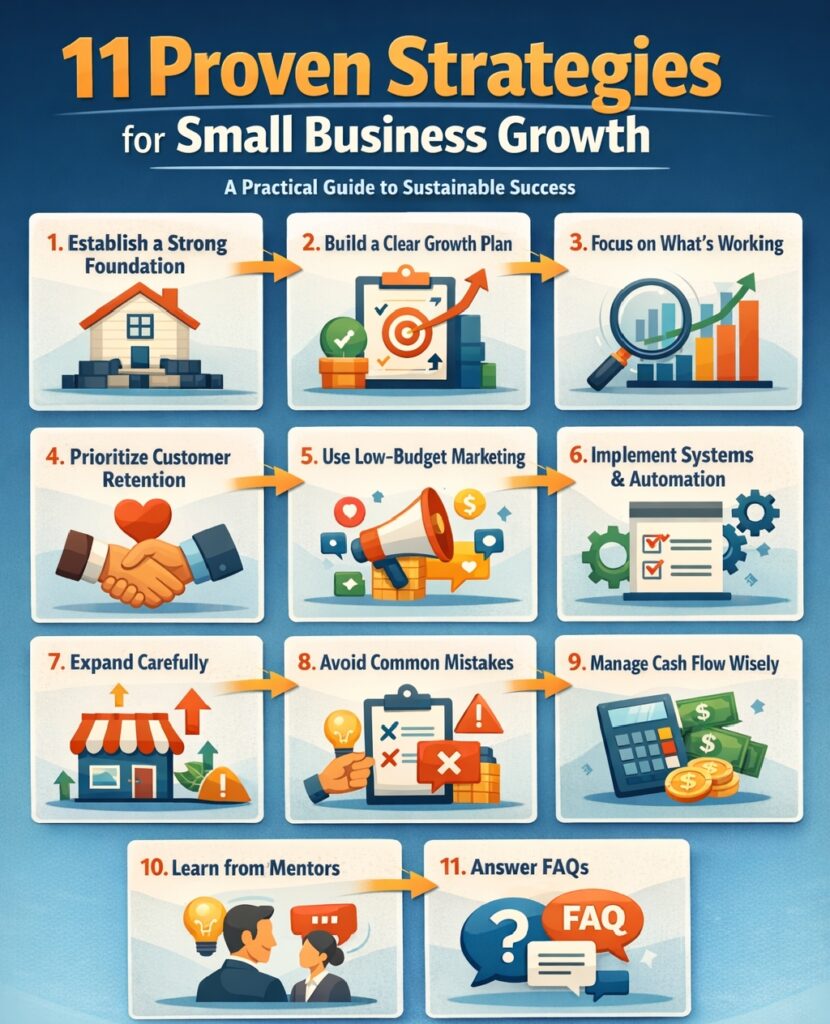
Introduction: Why Most Small Businesses Stay Stuck at the Same Level

Many small business owners do not struggle because they are lazy or lack ambition. In fact, most of the people I speak with are working long hours and doing their best to keep things moving. Yet growth still feels slow, unpredictable, or completely stuck. I have seen this pattern repeatedly while learning from established businesses, reading widely, and observing small businesses across Nigeria, Cameroon, and Sierra Leone.
One common misunderstanding is the belief that growth comes from working harder. But when you look closely at how successful companies operate, from structured businesses like Amazon to disciplined service companies highlighted in Harvard Business Review case studies, growth is rarely about effort alone. It is about clarity, systems, and choosing the right strategy at the right stage of the business. This perspective is well documented in research on sustainable growth and operational discipline, such as insights shared by Harvard Business Review on why many businesses plateau despite strong demand.
From conversations with friends like Tunde in Lagos, who runs a small logistics company, and Junior in Douala, who owns a growing retail shop, the story is similar. Sales may increase slightly, but profits remain tight. The owner becomes the bottleneck, handling everything, with no clear structure to support expansion. Over time, frustration sets in.
The truth is that many small businesses do not fail because they cannot grow, but because they try to grow without structure. Growth magnifies whatever already exists, whether that is clarity or chaos. Without the right foundation, even good opportunities can create more stress instead of progress.
This is why understanding small business growth strategies is not about chasing tactics. It is about learning how growth actually works, what it should look like at your stage, and how to approach it without burning out or breaking the business. Before exploring strategies, it is important to first clarify what growth truly means for a small business, which is exactly what the next section addresses.
Also want to read my guide on starting a side hustle as a 9-to-5 worker. Check it out HERE
What “Growth” Really Means for a Small Business
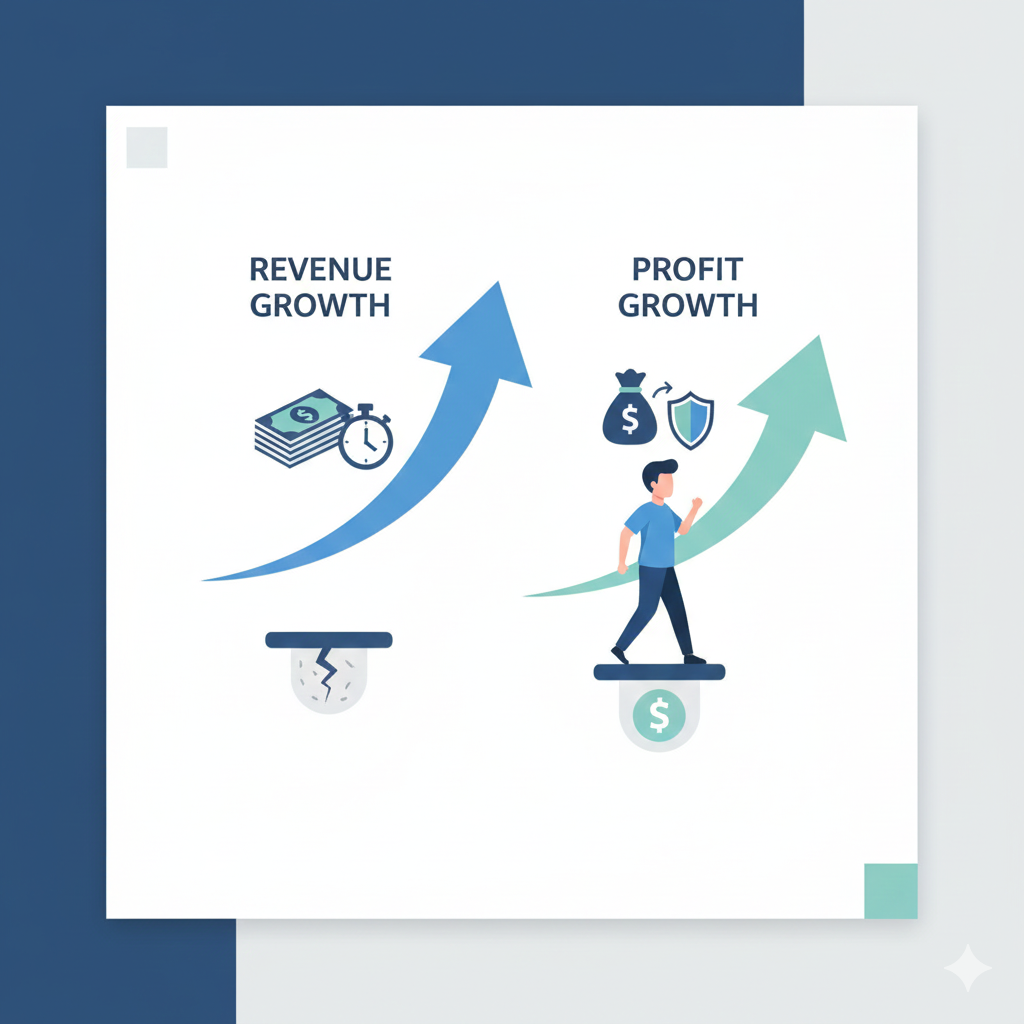
One reason many small business owners feel stuck is that growth is poorly defined. I have noticed, through discussions with friends running businesses and from studying how established companies operate, that people often chase revenue without understanding what kind of growth they actually need.
Growth is not just about making more sales. Revenue growth means money coming in, but profit growth is what keeps a business alive. I have seen small businesses in Cameroon and Nigeria increase sales month after month, yet struggle to pay suppliers or themselves because costs grew faster than income. This difference between revenue and profit is clearly explained in financial breakdowns like this one from Investopedia on profit vs revenue, which shows why higher sales do not always mean a healthier business.
Another important distinction is growth versus scaling. Growth often means adding more effort, more hours, or more resources to increase output. Scaling, on the other hand, means increasing results without a matching increase in effort. Many competitors mix these two ideas, but they lead to very different outcomes. Companies like Shopify openly explain this difference in their educational resources, especially when discussing sustainable business expansion.
There is also the human side. Growth without systems usually leads to burnout. I have seen this with a friend, Chinedu from Aba, Nigeria who expanded his manufacturing orders too quickly without processes in place. The business grew on paper, but stress and errors multiplied behind the scenes.
For small businesses, real growth means improved profitability, better systems, and more control, not just more activity. Understanding this sets the foundation for every strategy that follows.
Before applying any small business growth strategies, it is critical to ensure the business is actually ready to grow. That readiness is often overlooked, and it is exactly what the next section focuses on.
The Foundation First: Fix This Before Trying to Grow
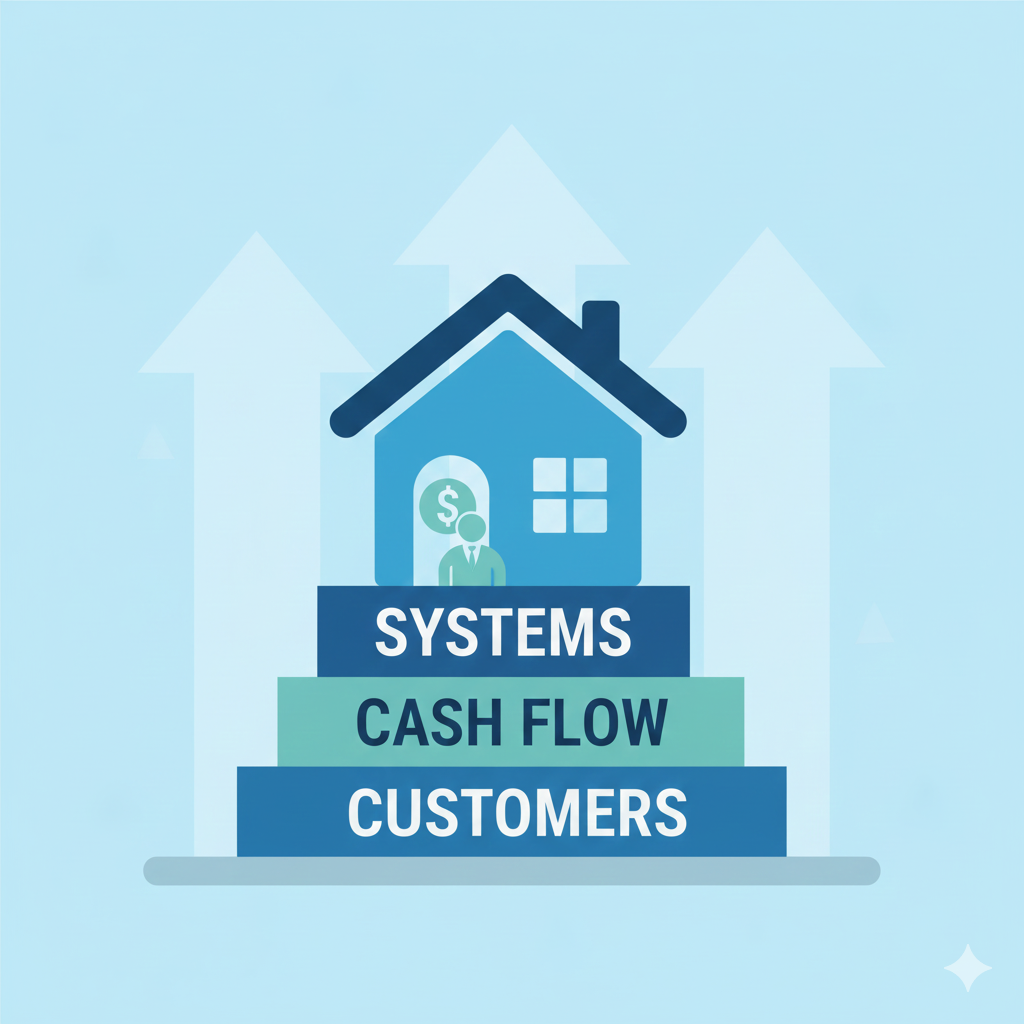
One mistake I have consistently observed is that many small business owners rush into growth without checking whether the business is stable enough to handle it. From mentoring small businesses in Cameroon and Sierra Leone, and through conversations with friends running enterprises in Nigeria, the pattern is clear. Growth does not fix weak foundations; it exposes them.
The first foundation is a clear offer and a defined customer. Many businesses struggle because they try to sell too many things to too many people. I remember a friend, Aisha, in Abuja, (Nigeria, who ran a beauty products business. Sales improved only after she narrowed her focus to one core product and one specific customer group. Research from HubSpot also highlights how clarity in the value proposition directly affects growth and customer retention.
The second foundation is basic financial visibility. You do not need complex accounting software, but you must know what is coming in, what is going out, and when. I have seen small businesses grow sales while silently running into cash flow problems. This is a common reason businesses collapse during expansion. The U.S. Small Business Administration explains why cash flow awareness is critical before growth.
Next are simple systems, not advanced tools. Systems can be as basic as documented steps for handling orders, customer follow-ups, or inventory tracking. Without these, the owner becomes the system, and growth becomes exhausting. Companies like McKinsey often emphasize that scaling magnifies existing inefficiencies rather than fixing them, a point reinforced in their operations insights.
The reality is simple. Growth multiplies whatever already exists in a business. If the foundation is weak, growth increases stress, errors, and confusion. Fixing the basics first creates a stable platform for applying small business growth strategies effectively.
With the foundation in place, the next step is to move from readiness to direction, starting with a clear and realistic growth plan.
Strategy 1: (Build a Simple but Clear Small Business Growth Plan)

Once the foundation is stable, the next logical step is direction. Without direction, even a well-prepared business wastes energy. This is where many small business owners get stuck, not because they are lazy, but because they operate without a clear growth plan.
A small business growth plan is not a complex document or a 40-page PDF. From studying how companies like Amazon started with focused, long-term thinking, and from lessons shared in books like Good Strategy Bad Strategy by Richard Rumelt, the pattern is clear. Effective growth plans are simple, intentional, and realistic. Amazon’s early strategy was not about doing everything; it was about doing a few things exceptionally well, then expanding deliberately.
At a small business level, a growth plan answers three basic questions.
Where is the business now?
Where does it realistically want to go?
And what must change to get there?
I have seen mentors in Nigeria and Cameroon guide small business owners to focus on one-year clarity instead of vague five-year dreams. A one-year plan creates momentum, while longer plans provide direction without pressure.
Another key part of planning is prioritization. Growth stalls when everything feels important. A friend of mine, Emmanuel from Douala, shared how his logistics business only started growing after he identified one priority: improving delivery reliability. Revenue followed after that focus became clear. Harvard Business Review also explains why prioritization is central to strategy, especially for smaller firms with limited resources.
It is also important to avoid unrealistic projections. Overestimating growth leads to poor decisions, hiring too early, overspending, or taking unnecessary risks. The Corporate Finance Institute provides a practical explanation of why conservative forecasting protects growing businesses.
A clear growth plan connects directly to the foundation discussed earlier. Once direction is defined, the next question naturally becomes, what is already working inside the business that can be strengthened
Strategy 2: (Know Exactly What Is Already Working and Double Down)
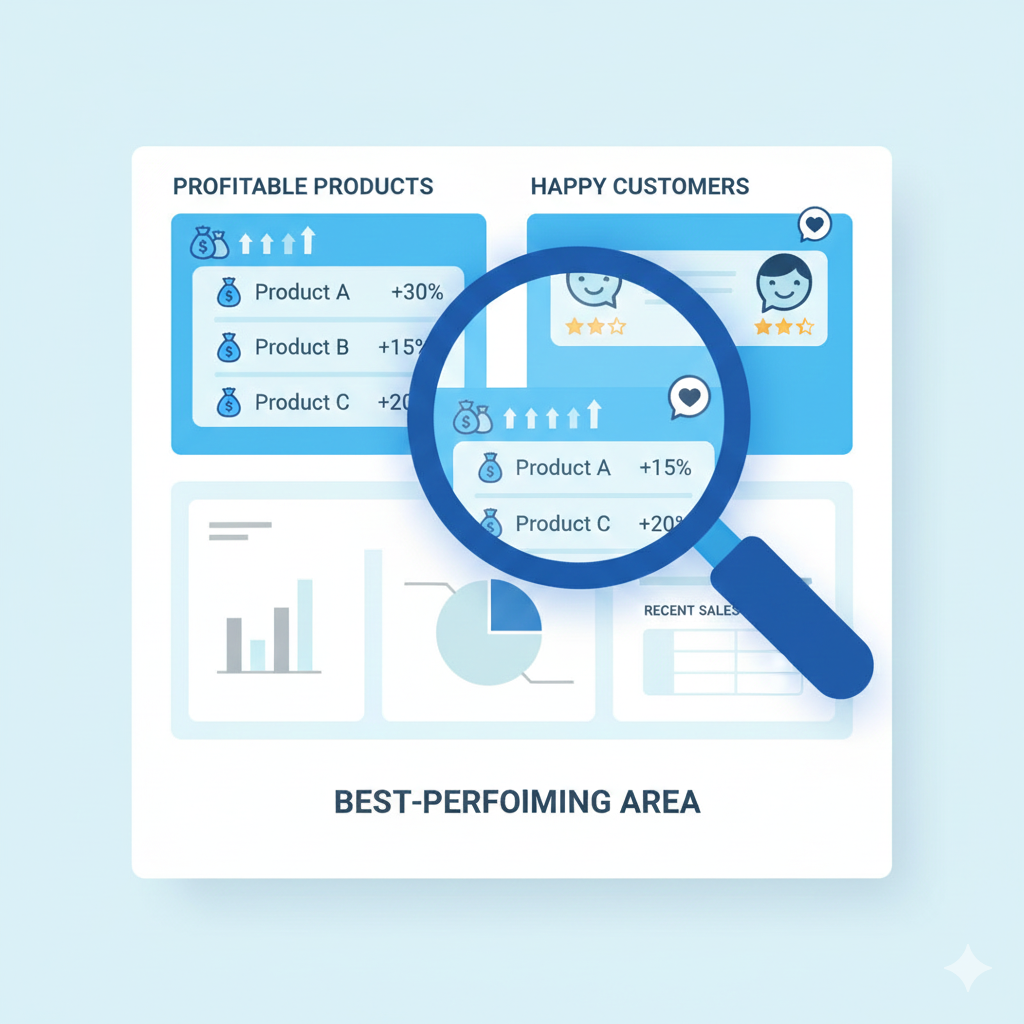
With a clear growth plan in place, the smartest next move is not expansion, it is focus. Before adding anything new, it is important to understand what is already producing results. Many businesses slow their growth by chasing new ideas while neglecting the activities that actually generate profit.
From mentoring small business owners in Cameroon and learning from peers in Nigeria, I have noticed a common pattern. Growth accelerates when owners stop guessing and start analyzing. This does not require advanced analytics. It starts with simple questions.
Which product or service brings in the most profit?
Which customers return consistently?
Which marketing effort brings results without draining resources?
A friend, Sorie from Freetown, once shared how his printing business struggled until he reviewed his numbers. He discovered that corporate clients, not walk-in customers, were responsible for most of his profit. By focusing his efforts there, revenue stabilized and stress was reduced. This principle is echoed by insights from Bain & Company, which shows that doubling down on core strengths often drives sustainable growth.
Understanding what works also means resisting the urge to add new offers too early. Many competitors recommend diversification quickly, but experience shows that complexity often kills momentum. McKinsey has published extensively on how complexity increases costs and reduces efficiency, especially in growing businesses.
Customer behavior is another powerful signal. Repeat purchases, referrals, and longer retention indicate value. If customers keep coming back, that is data worth listening to. According to research shared by Forbes, repeat customers spend more and cost less to serve, making them a strong growth lever.
This strategy ties directly into the next step. Once you clearly see what customers value and where profit truly comes from, the most logical move is to strengthen relationships with those customers instead of constantly searching for new ones. That shift leads naturally into the next growth strategy.
Strategy 3: (Customer Retention Before Customer Acquisition)

Once you know what is working and who your best customers are, the next growth lever becomes obvious. Instead of spending most of your energy chasing new customers, you grow faster by keeping the ones you already have. This is where many small businesses miss an easy opportunity.
From conversations with a mentor I worked with in Lagos, Kunle, one lesson kept repeating itself. New customers look exciting, but loyal customers keep the lights on. Retention creates predictable income, reduces marketing pressure, and gives you room to improve systems without panic.
Customer retention starts with experience.
How smooth is the buying process?
How well do you follow up after a sale?
Do customers feel remembered or forgotten?
According to Harvard Business Review, increasing customer retention by just 5 percent can increase profits by 25 to 95 percent, depending on the business model.
Simple actions often make the biggest difference. A clear follow-up message. A small bonus for repeat buyers. Asking for feedback and actually acting on it. A friend of mine, Esther, who runs a small skincare brand in Douala, shared how adding a simple thank-you message and reorder reminder increased repeat purchases without any paid advertising.
Referral systems also fall under retention. Happy customers naturally talk. The mistake is leaving referrals to chance. Word-of-mouth becomes more powerful when you give customers a reason and an easy way to refer others. Shopify explains how referral loops work well for small businesses without large budgets.
This approach also protects you from burnout. Constant customer acquisition feels like running on a treadmill. Retention feels more like building momentum. You are strengthening relationships instead of restarting every month.
There is also a financial angle. Acquiring new customers is more expensive than serving existing ones. HubSpot breaks down these cost differences clearly, especially for small businesses.
As retention improves, something else becomes clear. Growth begins to demand structure. More customers staying longer means more work, more communication, and more moving parts. That naturally leads into the next strategy, building systems and processes that support growth without overwhelming the business.
Strategy 4: (Low-Budget Marketing Strategies That Actually Work)
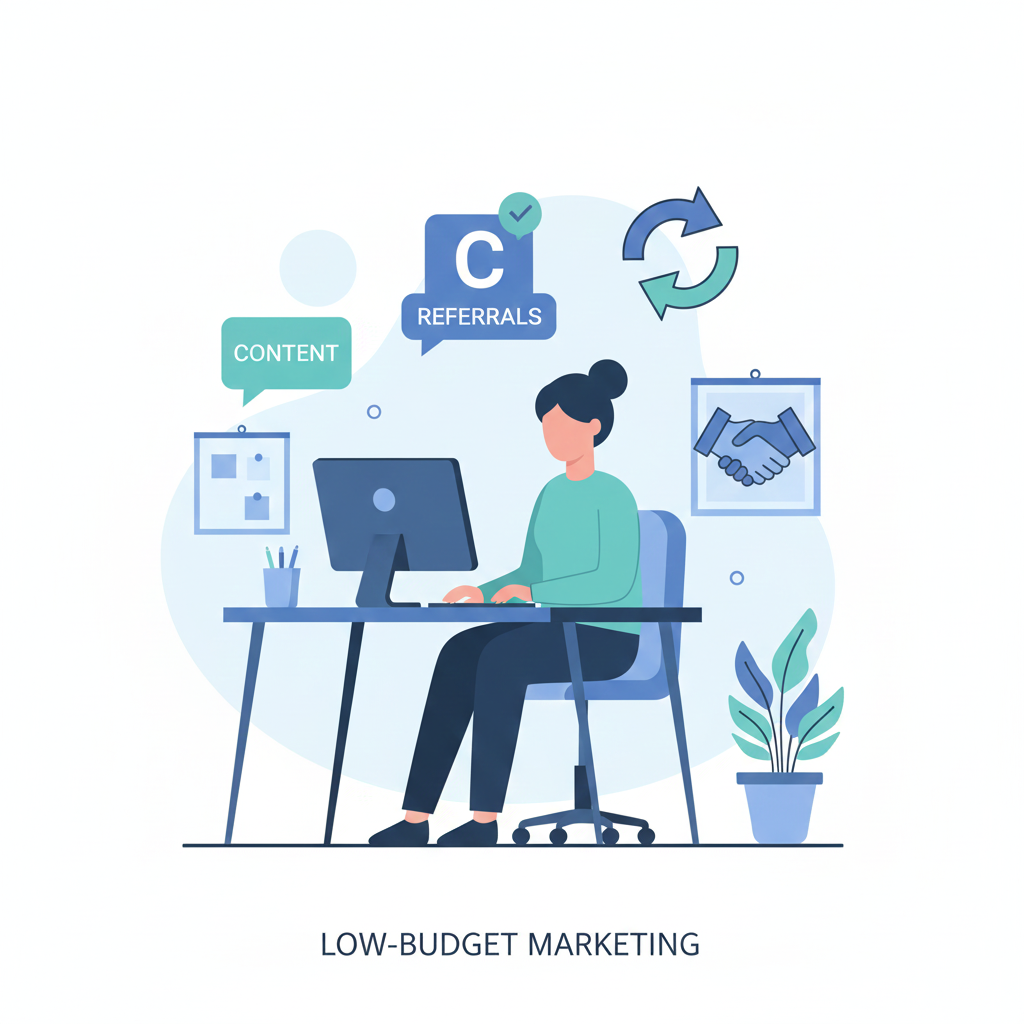
When customer retention is working, marketing pressure reduces. Instead of chasing attention everywhere, the focus shifts to channels that compound over time. This is where many small businesses with limited budgets can grow steadily without burning cash.
From observing small businesses in Nigeria and Cameroon, the most effective marketing is often not the loudest. It is the most consistent. A mentor I learned from in Yaoundé, Marcel, often said, Growth comes from showing up where your customers already trust you. That insight aligns with what platforms like HubSpot and Google consistently recommend for small businesses.
Content marketing is one of those channels. Whether through blog posts, short educational content, or email newsletters, content builds authority gradually. According to HubSpot’s small business marketing data, content marketing costs less than traditional marketing and generates more long-term leads.
Partnerships are another low-cost growth lever. Partnering with businesses that serve the same audience but offer different products allows both sides to grow faster. For example, a fitness coach partnering with a nutrition brand. Shopify explains how strategic partnerships help small businesses expand reach without large budgets.
Referrals, when structured properly, also fall into this category. A simple incentive or recognition system can turn happy customers into your most effective marketers. This builds directly on the retention strategy discussed earlier, creating a loop rather than a one-time effort.
Social platforms can work too, but the mistake is trying to be everywhere. The smarter move is to pick one platform where your audience is active and show up consistently. Buffer shares practical insights on choosing the right social channel for business growth.
Paid ads are often overhyped for early growth. Without clear data on what converts, ads can drain cash quickly. Many businesses scale ads too early instead of first proving their message organically. Google’s own small business resources recommend validating offers before scaling ads.
As marketing becomes more consistent and customer numbers increase, the business begins to feel heavier to manage. More inquiries, more follow-ups, more tasks. This is usually the signal that growth now depends less on effort and more on systems. That transition leads directly into the next strategy.
Strategy 5: (Systems, Automation, and Delegation for Sustainable Growth)
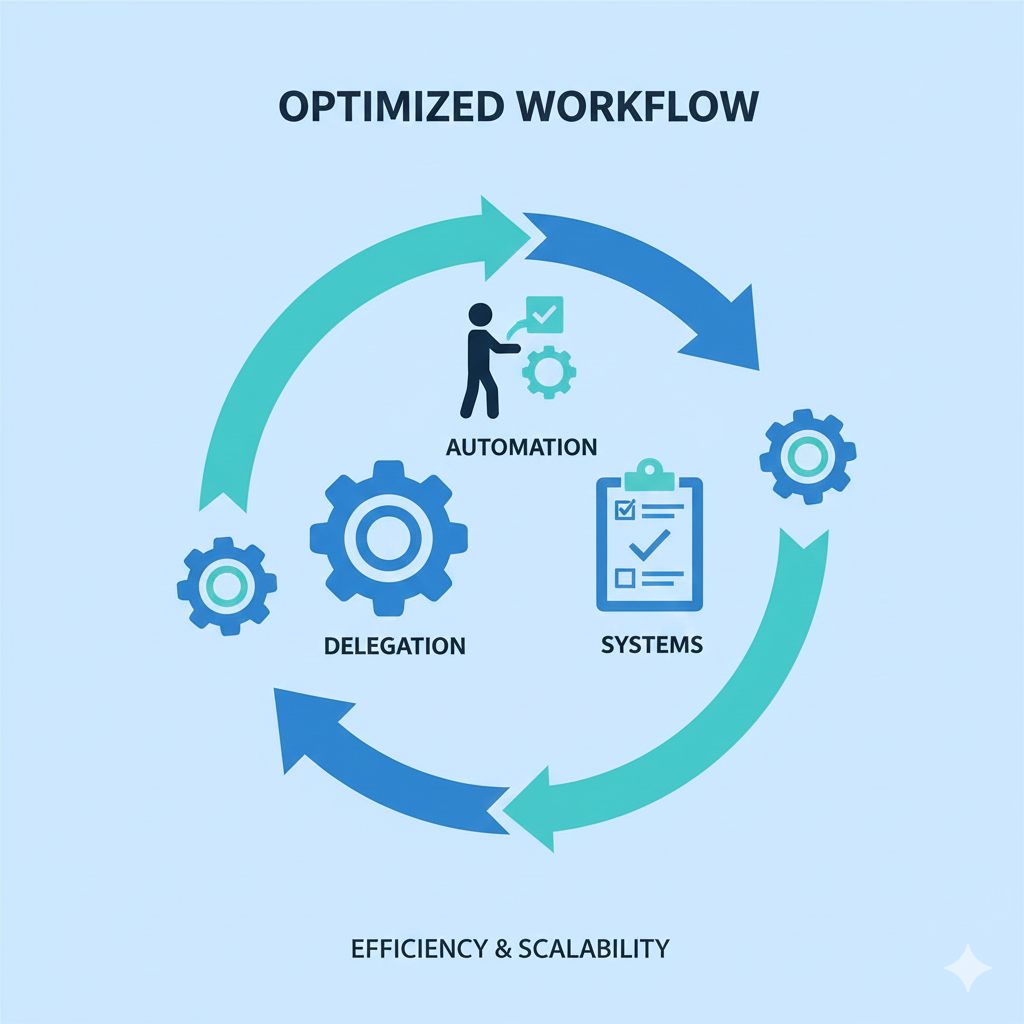
When marketing starts working and customers are coming in consistently, growth introduces a new challenge. The business begins to depend too heavily on the owner. This is where many small businesses stall, not because demand is lacking, but because structure is missing.
From mentoring conversations with small business owners in Nigeria and Sierra Leone, one lesson stands out clearly. Growth without systems creates chaos. A friend, Abdul from Makeni, shared how his logistics business almost collapsed because every task depended on him. Once he documented basic processes and delegated simple tasks, the business became easier to manage and more profitable.
Systems do not need to be complex. They start with repeatable actions. How orders are handled. How customers are followed up. How payments are tracked. According to McKinsey, even simple process standardization can significantly improve efficiency and reduce errors in growing businesses.
Automation comes next, but timing matters. Many businesses buy tools too early and end up overwhelmed. Automation works best when a process is already clear. Tools should support clarity, not replace it. Zapier explains this well in its guide on automation for small businesses.
Delegation is often the hardest shift. Letting go feels risky, especially when the business is personal. A mentor from Lagos once advised me that delegation is not about losing control; it is about protecting growth. Harvard Business Review supports this view, highlighting delegation as a core skill for scalable leadership.
The goal of systems, automation, and delegation is sustainability. Growth should make the business stronger, not more fragile. When structure supports demand, the business can expand without constant firefighting.
However, structure alone does not guarantee safe expansion. As capacity increases, new risks appear. Hiring too fast, cash flow strain, and operational pressure can undo progress if not managed carefully. That is why the next strategy focuses on expanding without breaking the business.
Strategy 6: (Expanding Without Breaking the Business)

Once systems are in place, expansion becomes possible, but this is also where the highest risks appear. Growth feels exciting, yet expanding too fast can undo years of effort. Many small businesses fail at this stage, not because demand disappears, but because the business stretches beyond its limits.
From mentoring experiences with business owners in Cameroon and Nigeria, a common warning keeps coming up. Expansion should follow stability, not ambition alone. A friend, Chinedu from Aba, shared how hiring three staff members at once nearly drained his cash flow. Sales were growing, but expenses grew faster. This lesson reflects what the U.S. Small Business Administration emphasizes about managing growth carefully.
Hiring is often the first expansion move, and also the most expensive. Bringing people in before processes are clear creates confusion and waste. According to Harvard Business Review, premature hiring increases operational risk and slows decision-making.
Cash flow management becomes even more critical during expansion. Growth consumes cash. More inventory, more salaries, and higher operating costs appear before revenue fully catches up. Investopedia explains how growing businesses often face cash flow gaps even when profits look good on paper.
Another overlooked aspect of expansion is knowing when to pause. Growth does not have to be constant. Strategic pauses allow the business to stabilize, review data, and fix weak points. McKinsey highlights that sustainable growth often includes periods of consolidation.
Expansion works best when it is intentional. Clear numbers, steady systems, and realistic pacing protect the business from collapse. When expansion is managed well, growth becomes repeatable rather than stressful.
After navigating expansion, it becomes clear that many struggles are avoidable. The same mistakes appear again and again across small businesses. Understanding these mistakes upfront can save years of frustration. That is the focus of the next section.
Common Small Business Growth Mistakes to Avoid
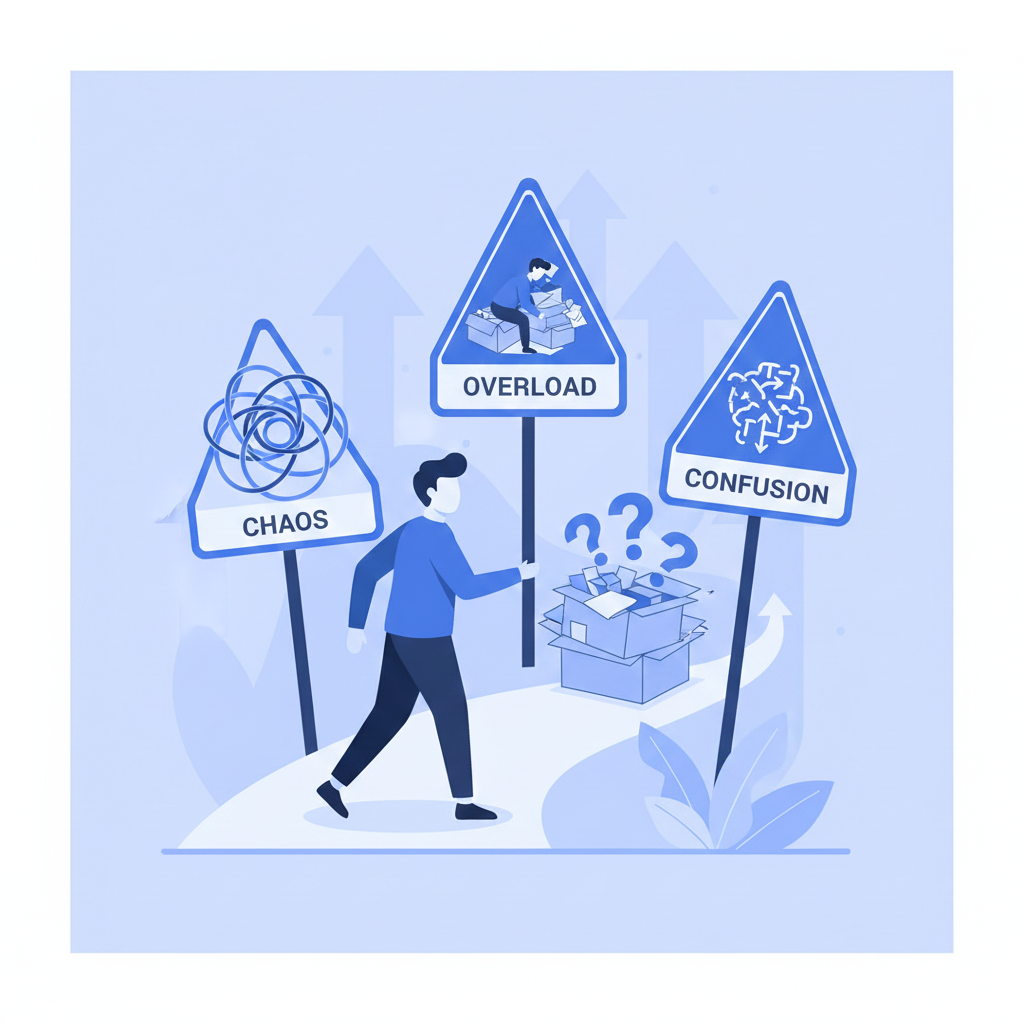
After working through the major growth strategies, patterns start to repeat. Many small businesses do not fail because growth is impossible, but because avoidable mistakes quietly slow or reverse progress. Recognizing these mistakes early can protect everything you are building.
One of the most common errors is chasing every opportunity. A mentor from Nigeria once warned that not every opportunity is meant to be taken. Growth requires saying no. According to Inc., spreading attention across too many initiatives weakens execution and delays results.
Another mistake is copying big companies without context. What works for large organizations often breaks small businesses. Bigger budgets, teams, and systems change the rules. Forbes explains why small businesses should avoid blindly following enterprise-level strategies.
Ignoring numbers is also costly. Growth without financial visibility leads to bad decisions. Many owners rely on bank balance instead of data. Investopedia stresses the importance of tracking key financial metrics, especially during growth phases.
Growing without clarity is another silent issue. Adding products, markets, or services without a clear reason creates complexity. Complexity increases costs and confusion, as highlighted in McKinsey’s research on operational efficiency
Finally, many businesses wait too long to seek guidance. Mentorship shortens learning curves. Learning from others who have faced similar challenges reduces trial and error. The Small Business Development Centers network emphasizes the role of mentorship in long-term business success.
Avoiding these mistakes does not guarantee success, but it significantly increases the odds. With the core strategies covered and common pitfalls addressed, the final step is to answer the questions most business owners still have in mind. That brings us to the frequently asked questions.
FAQs: Small Business Growth Strategies
What is the best growth strategy for a small business?
There is no single best strategy that fits every business. The most effective small business growth strategies are the ones that match the stage of the business. For early growth, clarity of offer and customer retention matter more than aggressive marketing. As the business matures, systems and controlled expansion become more important.
How long does it take to grow a small business?
Growth timelines vary widely. From observing small businesses in Cameroon, Nigeria, and Sierra Leone, meaningful growth often takes 12 to 36 months of consistent execution. Quick wins can happen, but sustainable growth usually follows steady improvements rather than sudden jumps.
Can a small business grow without a lot of money?
Yes, but it requires focus and patience. Many businesses grow through retention, referrals, partnerships, and content rather than heavy advertising spend. Low-budget strategies work best when systems are tight and customer value is clear.
What is the safest way to scale a small business?
The safest way to scale is to grow in layers. First stabilize revenue, then document systems, then delegate, and only after that expand capacity. Scaling without structure increases risk.
How do I know my business is ready to grow?
A business is usually ready to grow when it has consistent demand, positive cash flow, repeat customers, and basic systems in place. If growth only happens when the owner works longer hours, the business is not ready yet.
These questions reflect the real concerns behind searches for small business growth strategies. When answered honestly, they help business owners make better decisions and avoid unnecessary pressure as they move forward.
Conclusion: (Growing a Small Business Without Losing Control)
mall business growth is not about chasing every new idea or copying what large companies are doing. It is about understanding your stage, strengthening what already works, and growing at a pace your business can sustain. From lessons drawn from experienced business owners in Nigeria, Cameroon, and Sierra Leone, one truth remains consistent. Growth becomes easier when structure comes before expansion.
The strategies covered in this guide are not quick fixes. They are practical approaches that reduce risk, protect cash flow, and support long-term progress. When growth feels slow, it is often a signal to simplify, not to panic.