
Introduction
If you have been putting in the work but your small business growth still feels slow or inconsistent, you are not alone. Many business owners I have interacted with over the years face the same frustration, long hours, and daily hustle, yet results refuse to scale. The truth is, growth problems are rarely about laziness or lack of passion. In most cases, they are caused by repeated decisions and habits that quietly limit progress. This is one of the main reasons why small businesses fail to grow, even when demand exists.
Small business growth is not accidental. It is the result of strategy, clarity, and systems working together over time. Without these, effort turns into busyness, revenue becomes unstable, and expansion feels risky instead of exciting. I have seen businesses with strong products struggle simply because the foundation for growth was weak, while others with average offerings scaled faster by avoiding common growth traps.
This article breaks down the most common small business growth mistakes that slow momentum and keep owners stuck at the same level year after year. These mistakes show up across industries, from retail and service-based businesses to online and e-commerce brands. Even founders who have read guides like 10 Essential Tips for a Successful E-commerce Business often fall into these traps without realizing it.
You will learn how these mistakes create real business growth challenges, why they are so common, and what practical steps can correct them. The goal is not blame, but clarity. Once you can identify what is holding your business back, you can make smarter decisions on how to grow a small business sustainably, without burnout or guesswork.
By the end of this guide, you will have a clearer lens to evaluate your business and begin making growth decisions with confidence, not hope.
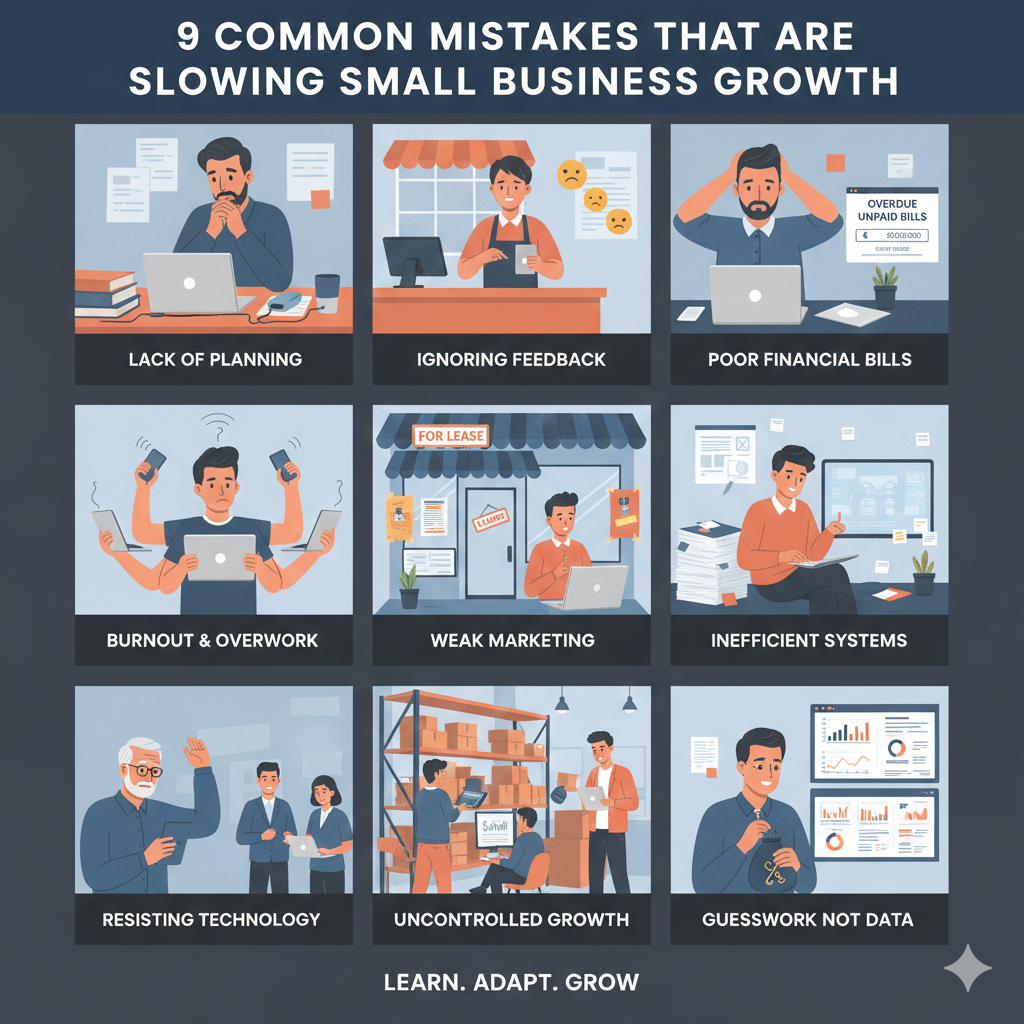
Mistake 1: No Clear Strategy for Small Business Growth

One of the most common reasons small business growth slows down is the absence of a clear strategy. Many small business owners are busy every day, posting on social media, responding to customers, running promotions, yet they cannot clearly explain how these actions connect to long-term growth. Being active is not the same as growing.
A growth strategy defines where the business is going, who it is serving, and how progress will be measured. Without this clarity, decisions become reactive. I have reviewed small businesses that jumped from one idea to another because competitors were doing it, or because a trend looked promising. The result was wasted time, scattered marketing, and inconsistent revenue. This is one of the most overlooked business growth challenges.
A real example can be seen in many local service businesses. A small printing company once focused on walk-in customers but suddenly tried to chase online orders without changing its pricing structure or delivery process. There was activity, but no direction. Revenue stayed flat because the move was not supported by a defined business growth strategy.
A clear strategy does not mean complexity. It starts with simple decisions.
What market segment are you prioritizing?
What problem do you solve better than your competitors?
What channels will drive visibility and sales?
When these answers are missing, growth becomes accidental instead of intentional.
Resources like 5 Must-Have Elements in a Small Business Marketing Plan (That Drive Real Growth) highlight how structured planning supports sustainable expansion. A strong strategy aligns marketing, operations, and finances around one growth direction.
How to fix it
To fix this mistake, step back from daily tasks and document your growth plan. Define your target customer, revenue goals, and the systems needed to support them. When strategy leads action, small business growth becomes predictable instead of stressful.
Mistake 2: Ignoring Customers and Market Feedback in Your Small Business Growth

Another major factor behind slow small business growth is ignoring customers and market feedback. Many business owners assume they already know what customers want, so they make decisions based on instinct rather than real input. Over time, this creates a gap between what the business offers and what the market actually needs. This is one of the quiet reasons why small businesses fail to grow even when demand exists.
I have seen this happen with retail and service-based businesses that continued offering the same products and pricing for years without asking customers for feedback. Sales started dropping, not because the market disappeared, but because customer expectations changed. When feedback is ignored, businesses miss early warning signs and growth opportunities.
Customer feedback does not always require complex systems or websites. For businesses that are just starting or operating offline, insights can come from direct conversations, WhatsApp chats, Instagram DMs, customer reviews, and simple follow-up questions after a purchase. Market feedback also includes observing buying behavior, repeated complaints, and frequently asked questions. These signals reveal business growth challenges long before revenue declines.
Large companies like Amazon built their dominance by obsessing over customer experience, not assumptions. While small businesses operate on a different scale, the principle is the same. Growth happens when decisions are shaped by real customer needs, not guesswork. Ignoring this is one of the most common small business growth mistakes.
How to Fix This Mistake
Start by intentionally listening. Ask customers why they chose your business and what could be improved. Use simple tools like Instagram polls, WhatsApp broadcasts, or post-purchase messages to collect feedback. Track repeated questions and complaints and adjust your offer accordingly. When customer insight guides decisions, small business growth becomes aligned with real market demand instead of assumptions.
Mistake 3: Poor Financial Control That Slows Small Business Growth

Poor financial control is one of the fastest ways to choke small business growth, even when sales appear healthy. Many business owners focus on making money but do not fully understand where the money goes. This confusion leads to cash shortages, unpaid bills, and stalled expansion. It is also a key reason why small businesses fail to grow despite consistent effort.
I have diagnosed several small businesses that claimed they were profitable, yet they struggled to restock inventory or pay staff on time. The issue was not low revenue; it was poor cash flow management. Revenue tells you how much comes in, but cash flow tells you whether the business can survive and grow. Without clarity, owners make emotional decisions that create long-term small business scaling problems.
A real-life example is many early-stage restaurants. They may be busy daily, but because costs are not tracked properly, profits disappear. In contrast, companies like Apple maintain strong growth partly because of strict financial discipline, cost control, and forecasting. Small businesses do not need complex systems, but they do need visibility.
Financial control means tracking income, expenses, profit margins, and cash flow regularly. Even simple tools like spreadsheets or accounting software can make a major difference. Resources such as Investopedia’s guide on cash flow management explain why understanding cash flow is critical for sustainable growth.
How to Fix This Mistake
Start by separating personal and business finances immediately. Track all income and expenses weekly, not monthly. Focus on cash flow, not just profit. Use simple tools like Wave or QuickBooks to stay organized. When finances are clear, decision-making improves, risks are reduced, and small business growth becomes sustainable rather than stressful.
Mistake 4: Trying to Do Everything Alone and Limiting

One silent killer of small business growth is the belief that the owner must do everything alone. In the early stages, this mindset feels responsible, but over time, it becomes one of the biggest business growth challenges. When one person handles sales, operations, marketing, customer service, and finances, growth slows, and burnout sets in.
I have worked with small business owners who were working 12 to 14 hours daily, yet results remained flat. The problem was not effort; it was capacity. Growth requires leverage. When all decisions and tasks depend on one person, the business becomes the bottleneck. This is one of the most common mistakes holding back business growth.
Large companies understand this principle well. For example, Amazon did not scale because Jeff Bezos did everything himself. Growth came from building teams, systems, and leadership layers. While small businesses operate on a different scale, the principle remains the same. You cannot scale what only you can do.
Trying to handle everything also affects quality. Marketing becomes inconsistent, customer service suffers, and strategic thinking disappears. Over time, this directly impacts small business success, such as consistency, focus, and long-term planning.
How to Fix This Mistake
Start by identifying tasks that do not require your direct involvement. Delegate repetitive work such as customer support, bookkeeping, or content scheduling. Use affordable tools like Trello or Asana to manage tasks efficiently. If hiring is not possible yet, consider freelancers through platforms like Upwork. By freeing your time to focus on strategy and growth, you remove a major barrier to small business growth and create room for scale.
Mistake 5: Weak Marketing and Visibility That Blocks

Another major reason small business growth stalls is weak or inconsistent marketing. Many business owners believe that having a good product or service is enough. In reality, if people do not know you exist or do not clearly understand your value, growth will always be limited. This is one of the most overlooked small business growth mistakes I see when reviewing struggling businesses.
I have diagnosed businesses with strong offers but poor visibility. Their messaging was unclear, their content was inconsistent, and their marketing channels were scattered. Some were posting randomly on social media, others relied only on word of mouth, and a few had websites that had not been updated in years. All these issues create confusion in the market and slow down their growth.
Strong marketing is not about doing everything; it is about doing the right things consistently. Businesses like Nike and Apple did not grow because of random promotion. They grew because of clear positioning, consistent messaging, and a deep understanding of their audience. For small businesses, the same principle applies. You need clarity before activity.
Weak marketing also leads to wasted money. Running ads without a clear message or target audience often results in poor returns. This becomes frustrating and reinforces the false belief that marketing does not work when the real issue is strategy. Without a solid plan, even good marketing tools will fail to support business growth.
If you want a structured way to fix this, the framework explained in 5 Must-Have Elements in a Small Business Marketing Plan (That Drive Real Growth) breaks down how to align marketing with real business goals.
How to Fix This Mistake
Start by clarifying your core message. What problem do you solve, for whom, and why should they choose you? Then choose one or two marketing channels that match your audience instead of spreading yourself wide. Focus on consistency, not perfection. Tools like Google Search Console can help you understand how people find your business online, while platforms like Meta Business Suite help you manage and analyze social media performance. With clear messaging and focused execution, marketing becomes a growth engine instead of a frustration point.
Mistake 6: Lack of Systems and Processes in Small Business

A hidden problem that quietly kills small business growth is the absence of systems and clear processes. Many small businesses operate entirely in the owner’s head. Tasks are done manually, decisions depend on memory, and operations change daily. This may work at the beginning, but it quickly becomes one of the biggest small business scaling problems as demand increases.
I have worked with business owners who were making sales but were constantly overwhelmed. Orders were delayed, customers complained, and nothing ran smoothly unless the owner was physically present. The issue was never effort; it was the lack of structure. Growth requires repeatability. If your business cannot deliver the same result without your constant involvement, scaling becomes impossible.
Think of how businesses like McDonald’s operate. The strength is not just the product; it is the system. Every process is documented, measured, and improved. Small businesses do not need complex systems, but they do need a basic structure. Without it, growth creates chaos instead of progress.
Lack of systems also affects team performance. When roles are unclear and processes are undocumented, mistakes increase and productivity drops. This directly slows business growth and creates frustration for both owners and staff.
If you are still building your foundation, it helps to understand how structure fits into the bigger picture. The guide How to Create a Winning Business Plan for Startups explains how systems, planning, and execution work together to support long-term growth.
How to Fix This Mistake
Start small by documenting your core processes. Write down how you handle sales, customer service, delivery, and payments. Use simple tools like Google Docs or Notion to organize workflows. Automate repetitive tasks where possible using tools like Zapier. Systems do not remove flexibility; they create freedom. Once your processes are clear, business growth becomes easier to manage and far less stressful.
Mistake 7: Fear of Change and Innovation Slowing Business Growth

One major reason small business growth stalls is the fear of change. Many business owners get comfortable with what already works, even when results are declining. They avoid new tools, new platforms, or new ways of serving customers because change feels risky. Unfortunately, this mindset creates serious business growth challenges.
I have seen small businesses reject digital tools because “we have always done it this way.” Some refused online payments, others ignored social media, and some avoided improving their customer experience. Meanwhile, competitors who embraced change slowly took their customers. Growth does not stop suddenly; it fades when innovation is ignored.
Look at companies like Netflix. They moved from DVD rentals to streaming long before DVDs stopped selling well. That decision protected their future. Small businesses face the same reality, just on a smaller scale. Customer behavior changes, technology evolves, and markets shift. Businesses that resist change fall behind, even if they work hard.
Fear also shows up as overthinking. Business owners delay decisions, wait for “perfect timing,” or stay stuck in learning mode without action. This hesitation directly slows small business growth and limits long-term potential.
If you want to understand how adaptability connects to visibility and customer acquisition, the article 9 Small Business Growth Strategies for Beginners explains how modern tools and strategies support sustainable growth.
How to Fix This Mistake
Start by testing change, not committing blindly. Try new tools on a small scale before fully adopting them. Follow industry blogs like HubSpot to stay informed about trends. Ask customers what they want and adapt based on real feedback. Innovation does not mean abandoning what works. It means improving continuously. When you embrace change strategically, small business growth becomes more resilient and future-proof.
Mistake 8: Scaling Too Fast Without Foundations

Another hidden problem that damages small business growth is trying to scale too fast without a strong foundation. Many business owners believe growth means expanding immediately, more products, more staff, more locations, or more ads. But scaling without preparation is one of the most common small business growth mistakes.
I have diagnosed businesses that doubled their marketing spend without fixing customer service or cash flow. Sales increased briefly, but refunds, complaints, and operational stress followed. Growth exposed weaknesses that were already there. This is why many businesses collapse right after a “good” sales season.
Big brands have learned this lesson the hard way, too. WeWork expanded aggressively across cities without stable financial systems or proven profitability. Rapid expansion looked like success, but weak foundations turned growth into a crisis. The same pattern happens in small businesses when systems, finances, and processes are not ready.
Sustainable business growth is built on demand, systems, and financial clarity. Without these, scaling creates chaos instead of progress. Growth should strengthen a business, not break it.
If you want to understand how planning protects expansion, the guide How to Create a Winning Business Plan for Startups explains how structure supports long-term success.
How to Fix This Mistake
Before scaling, confirm three things. First, ensure consistent demand, not one-time sales spikes. Second, build systems for operations, customer support, and finances. Third, check cash flow, not just revenue. Resources like Harvard Business Review highlight why controlled growth outperforms rapid expansion. When growth is intentional and supported by strong foundations, growth becomes sustainable and profitable.
Mistake 9: Not Tracking Performance Metrics for

One of the quietest but most dangerous small business growth mistakes is not tracking performance metrics. Many business owners rely on feelings, assumptions, or daily sales alone to judge progress. The problem is that growth without measurement is guesswork, and guesswork leads to poor decisions.
I have worked with businesses that believed marketing was not working, only to discover they never tracked where leads came from or which channels converted best. Others thought they were profitable but later realized costs were eating into margins. This is a common reason why small businesses fail to grow. They are moving, but they are moving blindly.
Large companies obsess over data for a reason. Amazon tracks everything from customer clicks to delivery speed. That level of insight allows them to improve continuously. While small businesses do not need complex dashboards, they do need clarity. Tracking the right numbers helps identify mistakes holding back business growth and reveals what is actually working.
Even simple metrics like monthly revenue trends, customer acquisition cost, repeat purchases, and marketing response rates can transform decision-making. When you measure performance, you gain control over business growth instead of hoping for results.
If you already run digital campaigns or content marketing, tools like Google Analytics and Meta Business Suite provide free insights that help small businesses make smarter decisions.
How to Fix This Mistake
Start simple. Choose five key metrics tied directly to growth, such as monthly sales, leads generated, conversion rate, customer retention, and profit margin. Review them weekly or monthly. Use the data to adjust strategy, not to criticize yourself. As Google explains in its analytics learning center, measurement helps businesses improve performance, not complicate it. When decisions are guided by data, small business growth becomes intentional and predictable.
How to Fix These Small Business Growth Mistakes and Move Forward

At this point, one thing should be clear: small business growth rarely stalls because owners are lazy or incapable. In most cases, growth slows because the same mistakes repeat quietly over time. The good news is that every mistake covered so far is fixable with clarity, discipline, and the right systems.
From working with small business owners across different industries, I have seen a clear pattern. Businesses that break growth plateaus do three things consistently. First, they simplify their strategy. Instead of chasing every opportunity, they focus on a few business growth strategies that align with their strengths and market demand. Second, they listen closely to customers and numbers, not assumptions. Third, they build systems that support scale, even when the business is still small.
If your challenge is weak planning or direction, revisiting your marketing foundation is a smart move. This is where having a structured marketing plan makes a difference. A helpful reference is this guide on the 5 Must-Have Elements in a Small Business Marketing Plan (That Drive Real Growth), which breaks down how strategy, targeting, and measurement work together.
Growth also becomes easier when lessons from other business models are applied. For example, many of the principles discussed in 10 Essential Tips for a Successful E-commerce Business apply beyond online stores, especially when it comes to customer experience, data tracking, and adaptability.
Fixing small business growth mistakes is not about an overnight transformation. It is about making better decisions repeatedly. Start with one correction at a time, document what works, and commit to consistency. When systems, strategy, and execution align, growth stops feeling random and starts becoming reliable.
Frequently Asked Questions About Small Business Growth
What is the biggest mistake slowing small business growth?
The biggest mistake slowing small business growth is operating without a clear and focused strategy. Many business owners stay busy but are not intentional about where the business is going. They jump from one idea to another, copy competitors, or chase short-term sales without thinking long-term. From my experience diagnosing small businesses, once the strategy is unclear, every other decision becomes reactive, and growth becomes inconsistent.
Why do small businesses stop growing after a while?
Many businesses grow to a certain point and then stall because systems, skills, and structure do not evolve with the business. This is one of the main reasons why small businesses fail to grow after early success. What worked when you had ten customers will not work when you have a hundred. Growth introduces new business growth challenges, such as managing cash flow, delegating work, and maintaining quality at scale.
How long does small business growth take?
There is no fixed timeline for small business growth. Some businesses see steady progress within months, while others take years to build momentum. Growth depends on factors like market demand, execution, financial control, and consistency. What matters most is tracking progress and making small improvements regularly rather than expecting quick wins.
Can a small business grow without investors?
Yes, a small business can grow without investors. Many successful companies started by reinvesting profits, controlling costs, and growing step by step. I have seen businesses grow sustainably by focusing on cash flow, improving customer retention, and applying practical business growth strategies instead of relying on external funding too early.
What are the best ways to grow a small business?
The best ways to grow a small business include setting clear goals, understanding customers deeply, strengthening marketing visibility, tracking performance metrics, and building systems that support scale. Growth becomes more predictable when decisions are guided by data, customer feedback, and a long-term plan rather than guesswork.
Conclusion: Turning Small Business Growth Mistakes Into Momentum
Small business growth rarely fails because of a lack of effort. In most cases, it slows down because of repeated mistakes that go unnoticed for too long. From unclear strategy and weak marketing to poor financial control and lack of systems, these issues quietly block progress until growth feels impossible.
The good news is that business growth is not reserved for big companies or well-funded startups. It becomes achievable when you identify what is holding you back and take deliberate steps to fix it. Over the years, while reviewing and advising different small businesses, I have seen that the ones that grow consistently are not perfect, but they are intentional. They listen to customers, track performance, adapt to change, and invest in structure before scaling.
If your business feels stuck, do not assume you need a completely new idea. Often, growth begins by correcting the fundamentals. Start with one mistake you recognized in this guide and address it properly. Small changes, applied consistently, lead to long-term results.
Remember, sustainable growth is not about rushing. It is about clarity, discipline, and applying proven business success strategies that align with your stage of business. With the right focus and patience, growth stops being a struggle and starts becoming a process you can control.