
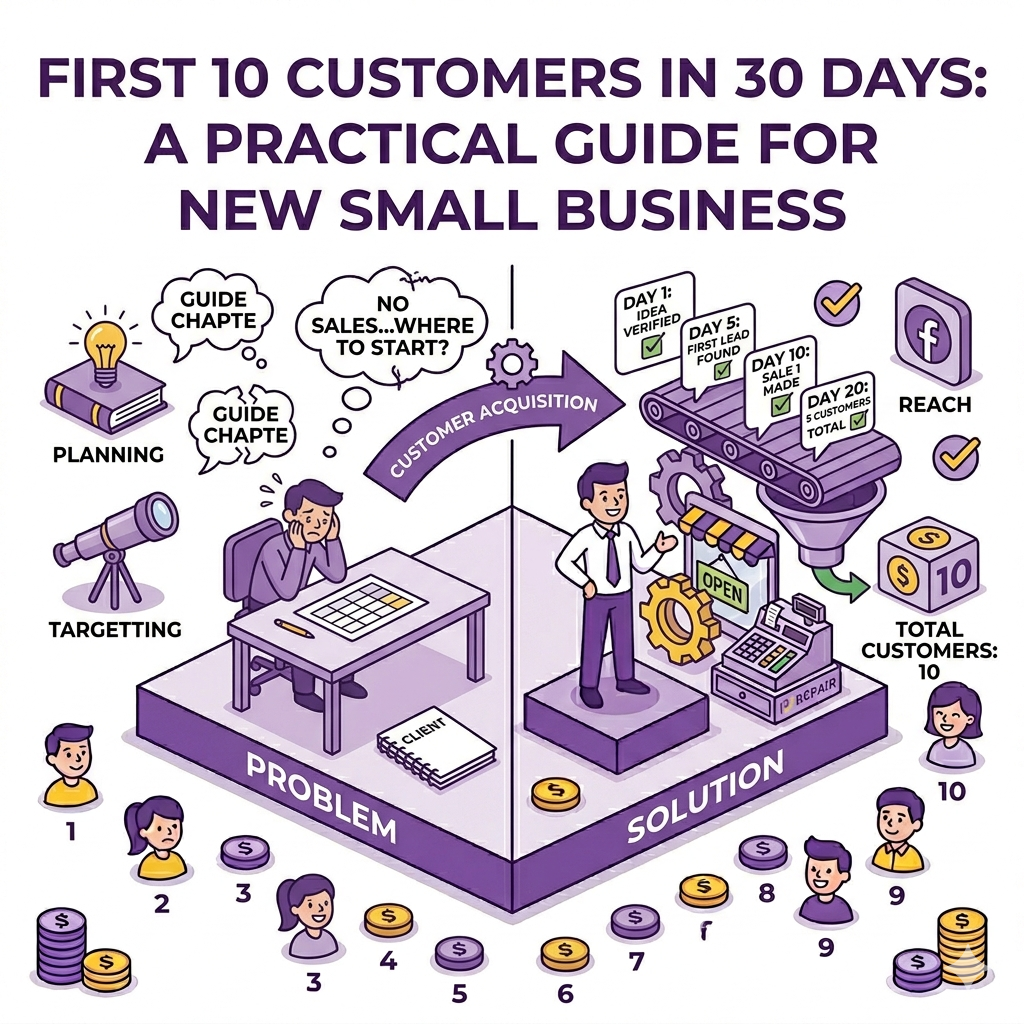
The Psychological Barrier: Why the First 10 Customers are the Hardest

In my journey of researching the world’s most successful startups and coaching founders through INSPIRED TO PROSPER, I’ve discovered a universal truth: learning how to get your first 10 customers is significantly harder than getting the next 100. When you have zero customers, you have no social proof, no testimonials, and, most importantly, a mountain of self-doubt. I remember talking to a brilliant entrepreneur recently who had a world-class product but was paralyzed by the “0 to 1” gap. They felt like they were shouting into a void where nobody was listening.
The reason most people fail at this stage isn’t a lack of talent; it’s a lack of a systematic business growth plan for beginners. They try to do everything at once: ads, SEO, expensive branding, without realizing that early-stage business development is actually about manual, unscalable labor. I always tell my clients that you have to “do things that don’t scale” to get the momentum you need to eventually fly. This blog post is designed to strip away the fluff and focus purely on customer acquisition for startups through direct action and grit.
Case Study: The Airbnb “Cereal Box” Hustle
I love studying the early days of Airbnb because they are the ultimate example of this. Before they were a billion-dollar giant, they couldn’t get anyone to use their site. Instead of running expensive ads, the founders literally sold collectible cereal boxes to fund their business and went door-to-door in New York to take professional photos of apartments themselves. They didn’t wait for a “viral” moment; they manually recruited their first 10 hosts. This proves my core philosophy: finding your first clients isn’t about a magic algorithm; it’s about doing the work that others are too proud to do.
To succeed, you have to realize that your first 10 customers are actually your “co-creators.” You aren’t just selling to them; you are learning from them to refine how to launch a small business that lasts. If you’re ready to stop overthinking and start doing, let’s get into the pre-launch essentials.
Phase II: The Pre-Launch Checklist Setting the Stage for Acquisition
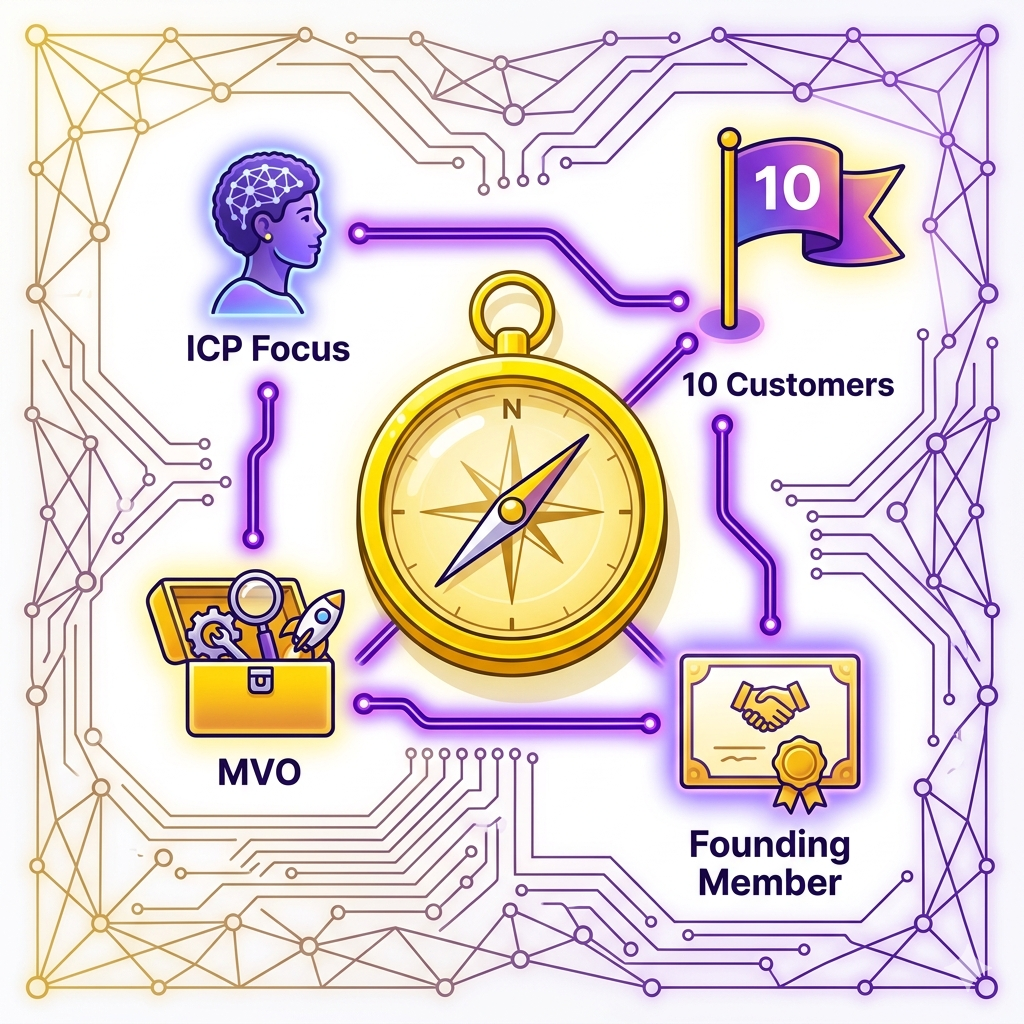
Before I ever advise a founder to send their first outreach email, I tell them we have to do the “quiet work.” You can’t succeed at finding your first clients if you are throwing a wide net into an empty ocean. In my research, I’ve found that the biggest reason startups fail in the first 30 days is “Vague Targeting.” If you say your product is for “everyone,” it is actually for no one.
To master how to get your first 10 customers, you must define your Ideal Customer Profile (ICP) with surgical precision. I want you to picture one person. What keeps them awake at 3:00 AM? What is the one problem they would pay any amount of money to solve right now? When I coach new business owners, I push them to find their “Desperate Buyer.” These are the people who don’t care if your website is perfect or if you have 100 reviews; they just need the solution you have. This is the heart of early-stage business development.
Case Study: How Canva Found Its First 100 “Power Users”
I love the story of Melanie Perkins, the founder of Canva. When she was starting, she didn’t try to take on Adobe Photoshop immediately. Instead, she focused on a very specific niche: high school yearbook designers. They had a massive problem (complex design software) and a hard deadline. By solving that one “micro-problem” for a small group, she refined her customer acquisition for startups strategy before scaling to millions. She didn’t wait to be perfect; she found a “desperate” niche and dominated it.
Once you know who they are, you need a Minimum Viable Offer (MVO). This isn’t your whole business plan; it’s the “hook.” My advice? Use a “Founding Member” incentive. Tell your first 10 prospects: “I am launching this new service, and I want you to be one of my 10 founding members. In exchange for your honest feedback and a testimonial, I’m giving you 50% off for life.” This uses the psychology of scarcity and belonging to drive entrepreneurship tips for new businesses into actual bank deposits.
If you aren’t sure how to structure this offer, I highly recommend reading my guide on how to create a winning business plan for startups. It will help you map out your value proposition so it’s crystal clear before you start your outreach. According to recent studies by the Small Business Administration, businesses that start with a documented plan and a clear target market are 16% more likely to survive the first year.
Week 1: Foundation & Digital Presence (The Setup)
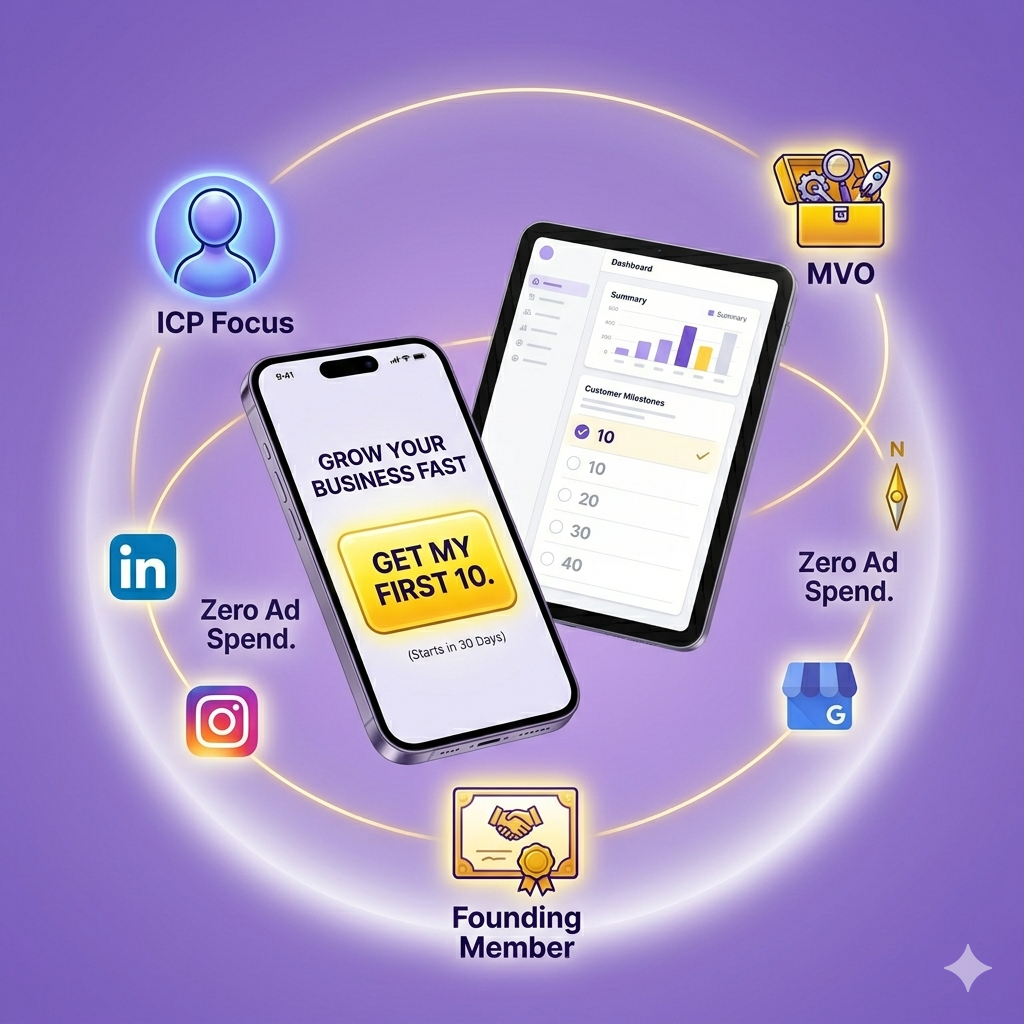
During the first seven days of your 30-day sprint, I want you to focus on building a “digital home” that converts visitors into leads. In my research, I see too many founders wasting weeks and thousands of dollars building complex websites before they even have one customer. I’m telling you right now: stop it. You don’t need a 20-page site; you need a high-converting landing page that proves you can solve a specific problem.
This is the core of low-cost marketing for small businesses. You want to leverage free platforms like Google Business Profile, LinkedIn, and Instagram to create a footprint that screams “authority.” When I coach early-stage founders, I tell them to focus on “Social Proof by Proxy.” If you don’t have testimonials yet, show your process. Show the research. Show the “behind-the-scenes” of how you are building your offer. This builds trust before the first transaction even happens.
Case Study: The “Buffer” Landing Page Strategy
I love the story of Joel Gascoigne, the founder of Buffer. When he was figuring out how to launch a small business, he didn’t build the full app first. He built a simple two-page site. The first page explained the value proposition, and the second page was a pricing table. If people clicked a plan, they saw a message saying, “We aren’t quite ready yet. Leave your email for updates.” This allowed him to validate customer acquisition for startups without writing a single line of complex code. He got his first 10 “believers” just by testing a headline.
To make this work for you, your landing page must answer three questions in five seconds:
- What do you do?
- How does it make my life better?
- How do I buy it?
If you make it any more complicated than that, you are practicing one of the nine common mistakes that are slowing your small business growth. According to data from Unbounce, the average conversion rate for a landing page is around 4.02%, but simplified pages focused on a single call-to-action can perform significantly higher.
During this first week, your goal isn’t “perfection”; it’s “visibility.” I want you to set up your profiles and start the “Feedback Loop.” Reach out to five people in your target niche and say: “I’m not selling anything yet, but I’m building a solution for [Problem]. Can I get 10 minutes of your advice on my landing page?” This is the most underrated of all entrepreneurship tips for new business people love giving advice, and often, those “advisors” become your first 10 customers.
Week 2: Warm Outreach & The Power of Your Network

In my research and coaching sessions, I’ve found that the fastest way to get your first 10 customers is sitting right in your contact list. I call this the “Inner Circle Strategy.” Too many people try to find strangers on the internet before they’ve even told their friends, family, and former colleagues what they are building. I’ve seen founders spend months on customer acquisition for startups using cold emails, only to find their first three clients were actually people they already knew.
This week is about the “50-Person Reach-Out.” Your goal is to identify 50 people who either need your service or know someone who does. But here is the secret: don’t “sell” to them. Use the “Beta Tester” script. I’ve coached my clients to say: “I’m launching a new project called [Business Name], and I’m looking for 10 ‘Founding Members’ to test the process at a massive discount in exchange for a testimonial.” This removes the pressure and makes them feel like they are doing you a favor while getting a great deal.
Case Study: How Dropbox Used a Simple Video to Get 75,000 Signups
I love the story of Drew Houston, the founder of Dropbox. When he was in the early stage of business development, he didn’t have a finished product. He made a simple 3-minute video demonstrating how it would work and shared it with his network and on tech forums. He didn’t have a marketing budget; he just had a clear demonstration of value. The video went viral within his “warm” niche, and his waiting list jumped from 5,000 to 75,000 overnight. This is the power of finding your first clients through an authentic demonstration rather than a hard sell.
If you’re worried about being “that person” who pestered their friends, remember that entrepreneurship tips for new businesses always emphasize solving problems. If your business actually helps people, you are doing your network a disservice by staying quiet. I always tell my students: if you believe in your value, silence is a disservice.
To keep your momentum high this week, you need to be organized. If you haven’t already, take a look at my list of 11 essential tools that support small business growth in 2026. Using a simple CRM or even a well-organized spreadsheet to track who you’ve messaged and who has replied is the difference between a professional and a hobbyist. According to research from HubSpot, personalized outreach and networking are still the top-rated ways for small businesses to gain initial traction because they build a foundation of trust that cold ads simply cannot match.
Week 3: Strategic Content & Community Engagement
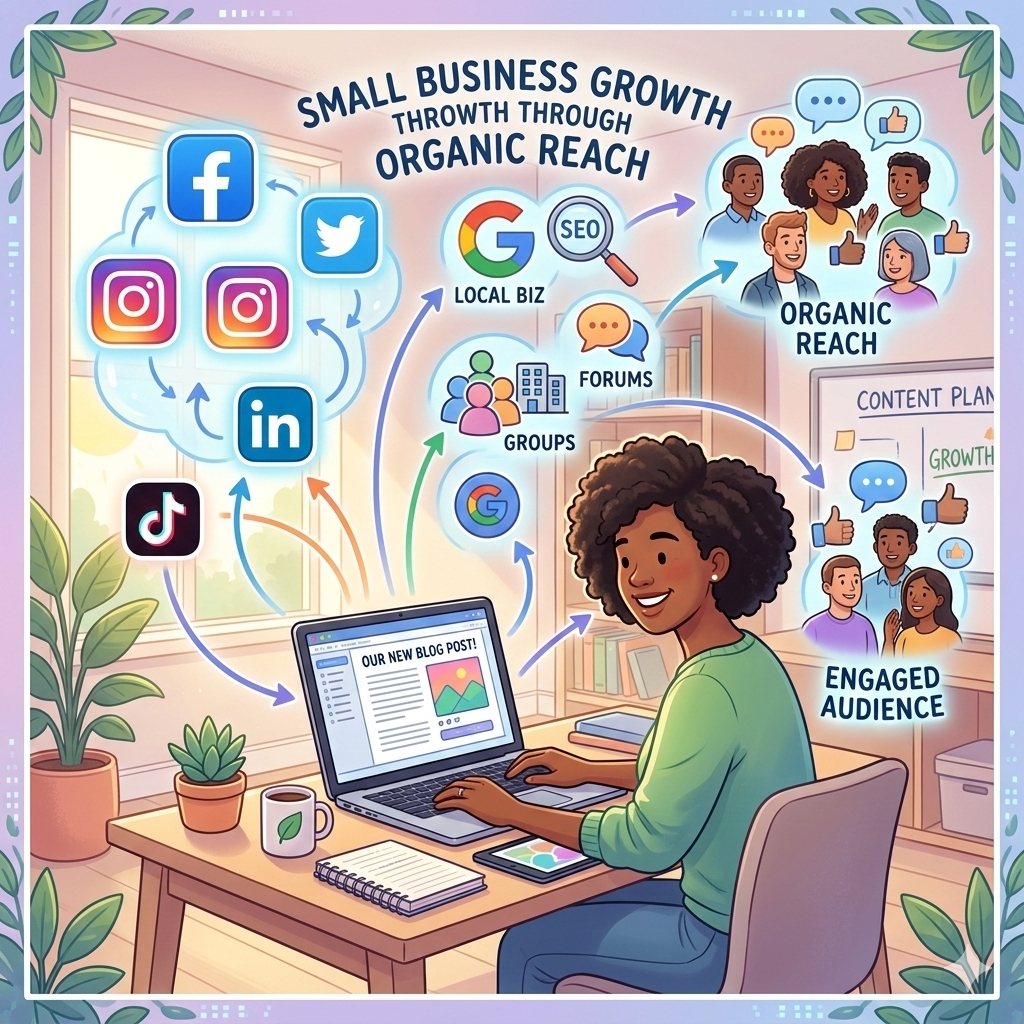
By the time you hit Day 15, your goal is to move beyond your immediate circle and start “Infiltrating” the digital spaces where your target customers hang out. In my research into small business marketing strategies, I’ve found that the most successful founders don’t just broadcast their message; they join the conversation. Whether it’s a Facebook Group, a Reddit sub-thread, or a niche Slack community, your task this week is to become a “Value Machine.”
I’ve seen too many entrepreneurs get kicked out of groups because they join and immediately post a link to their product. That isn’t customer acquisition for startups; that’s spam. Instead, I coach my students to use the “80/20 Rule”: 80% of your time should be spent answering questions and giving free advice, and only 20% should be spent mentioning your solution. When I started researching how to build authority for INSPIRED TO PROSPER, I realized that the person who solves the most problems for free is the person everyone eventually wants to pay.
Case Study: How “The Hustle” Used Community to Build a Media Empire
I love the story of Sam Parr, the founder of the newsletter The Hustle. Before he had a massive list, he used to go into Reddit and Facebook groups for entrepreneurs. He didn’t just share his link; he wrote massive, high-value posts explaining exactly how he organized events or how he wrote copy. He became the “go-to” expert in those groups. By the time he asked people to sign up for his newsletter, he already had hundreds of “believers” who trusted his early-stage business development insights. He built his first 1,000 subscribers purely by being the most helpful person in the room.
To do this effectively, you need educational content marketing. This means creating posts that focus on “Solving, not Selling.” If you are a digital marketer, don’t just say “Hire me.” Instead, write a post titled “The 3 things I saw on 50 landing pages this week that are killing conversions.” This proves your expertise and naturally leads people to ask, “Can you look at mine?” This is the ultimate of all entrepreneurship tips for new businesses because it turns a “cold lead” into a “warm inquiry” through the power of proof.
If you are struggling with what to post, I recommend looking at my guide on how to market your small business in 2026 without wasting a kobo on ads. It breaks down how to create “magnetic” content that draws people to you. According to data from Content Marketing Institute, 71% of B2B marketers say content marketing has become more important to their organization in the last year, proving that value-first communication is the standard for low-cost marketing for small businesses.
Week 4: The Closing Sprint & Referral Engines
As you enter the final seven days of your 30-day sprint, the pressure shifts from “finding” to “closing.” In my coaching sessions at INSPIRED TO PROSPER, I’ve noticed that this is where many founders hesitate. They’ve done the research, they’ve posted the content, but they are afraid to ask for the sale. I’m here to tell you: If you don’t ask, the answer is always no. This week is about mastering the art of the “Closing Sprint” by using early-stage business development techniques that turn “maybe” into “yes.”
One of the most effective strategies I’ve researched for how to get your first 10 customers is the “Launch Deadline.” Humans are hardwired to procrastinate until there is a consequence. I tell my clients to set a firm cutoff date for their “Founding Member” offer. Tell your prospects: “The 50% discount and the bonus consulting session expire this Friday at midnight because I’m shifting my focus to delivering results for my first group.” This isn’t just a sales tactic; it’s a commitment to your own time and value.
Case Study: How “The Muse” Used a Simple Referral Loop
I love the story of Kathryn Minshew, the founder of The Muse. When she was in the early stages of customer acquisition for startups, she didn’t just stop when she got a user. She asked every single person who signed up: “Who are two other people you know who are struggling with their career right now?” Because she had already provided immense value, people were happy to refer their friends. This “One-for-One” referral engine meant that every 1 customer she found manually brought in 1.5 more through word-of-mouth. This is how you turn a linear business into an exponential one.
To make this work, you must be prepared to handle objections. When a prospect says, “It’s too expensive,” I want you to lean into your entrepreneurship tips for new businesses training. Don’t lower the price immediately. Instead, ask: “Is it the price, or are you not sure if the result is worth it yet?” If it’s the latter, offer a “100% Satisfaction Guarantee.” For your first 10 customers, your reputation is worth more than the cash. If you can’t get them a result, you shouldn’t keep their money.
As you navigate these final negotiations, refer back to my guide on the 9 small business growth strategies for beginners. It contains the mindset shifts you need to stay confident when talking to high-value clients. According to data from Harvard Business Review, increasing customer retention rates by just 5% can increase profits by 25% to 95%. This proves that your focus this week shouldn’t just be on getting the 10th customer, but on setting up the systems to keep all 10 happy and referring others.
Now that the adrenaline of the 30-day sprint has settled, it’s time to shift our focus from “survival” to “scaling.” In my research and the sessions I’ve held at INSPIRED TO PROSPER, I’ve seen many founders make the mistake of stopping the manual work once they hit that magic number of 10. But the truth is, how to get your first 10 customers is just the “Proof of Concept.” To move from 10 to 100, you have to stop being a “founder-hustler” and start being a “system-builder.”
The Long Game: Transitioning from 10 to 100

In this phase of early-stage business development, your most valuable asset isn’t your product; it’s the data you just collected. I want you to sit down and look at those 10 people. Where did they come from? Which message finally made them say “yes”? If 7 out of 10 came from your LinkedIn outreach and only 1 came from Facebook, I’m telling you now: stop doing Facebook. Double down on what works. This is how you evolve your 30-day sprint into a long-term business growth plan for beginners.
Case Study: How Monday.com Used “Hyper-Specific” Scaling
I love the story of the team behind Monday.com (formerly daPulse). When they were in the customer acquisition for startups phase, they didn’t try to market to “everyone who needs a project manager.” They looked at their first small group of users and realized that creative agencies were getting the most value. Instead of staying general, they pivoted their entire marketing engine to speak specifically to agencies. By narrowing their focus, they actually expanded their growth. They proved that the riches are in the niches.
Once you have your “Proof of Profit,” it’s time to look at small business marketing strategies that leverage your existing success. This is where you turn those 10 customers into your marketing department. Ask them for case studies. Record a 2-minute video interview with them. When a prospect sees that 10 other people have already taken the risk and won, their “fear of buying” disappears. This is the ultimate of all entrepreneurship tips for new businesses: your customers’ voices are 10x more powerful than your own.
As you look toward the next 90 days, you might find that you need more robust systems to handle the load. I suggest you revisit my list of 11 essential tools that support small business growth in 2026 to automate your onboarding and lead tracking. According to research from Gartner, companies that prioritize “Marketing Operations” and automation in their early stages scale 2.5 times faster than those that don’t.
By the time you reach Customer #100, your business should feel less like a “sprint” and more like a “marathon” that you are winning. You’ve moved from finding your first clients through grit to attracting them through authority. Remember, the goal of INSPIRED TO PROSPER is to help you build something that doesn’t just survive but flourishes.
We are in the final stretch. In my consultations, I’ve found that even after a 4,000-word guide, founders still have those “What if?” questions. To ensure your business growth plan for beginners is airtight, I’ve compiled the most common hurdles I see in the field.
Frequently Asked Questions (FAQ Section)
1) What is the fastest way to get your first 10 customers?
In my research and the many sessions I’ve held at INSPIRED TO PROSPER, the fastest way is always direct, personalized outreach. Forget the “viral” posts or complex SEO for a moment. Picking up the phone, sending a personalized LinkedIn video, or walking into a local business is the most effective way of finding your first clients. It’s about human connection, not an algorithm.
2) How much should I spend on marketing in the first 30 days?
I always tell my students: your budget in the first month should be closer to $0 than $1,000. You need “Sweat Equity,” not “Paid Traffic.” By focusing on low-cost marketing for small businesses, you force yourself to refine your message. If you can’t sell your product for free using organic small business marketing strategies, throwing money at ads will only help you lose money faster.
3) Is it okay to offer my services for free to get the first 10?
This is a “Researcher’s Insight” I feel strongly about: only offer it for free if you are getting a public testimonial and a case study in return. If you give it away for nothing, the customer won’t value it. I suggest a “Beta Price,” something that covers your costs but is a “no-brainer” for the customer. This is a key part of early-stage business development; you need skin in the game from both sides.
4) How do I find my first clients if I have no portfolio?
You sell the Process and the Guarantee. If you don’t have a past, sell the future. Show them the deep research you’ve done and offer a “Pay-on-Results” model for the first three people. I’ve coached many founders who used this exact method to build their first portfolio in under 30 days. For more on this, check out my guide on the 12 low-capital businesses you can start with $100 in 2026 to see how to start from scratch.
5) What are the best customer acquisition strategies for startups on a budget?
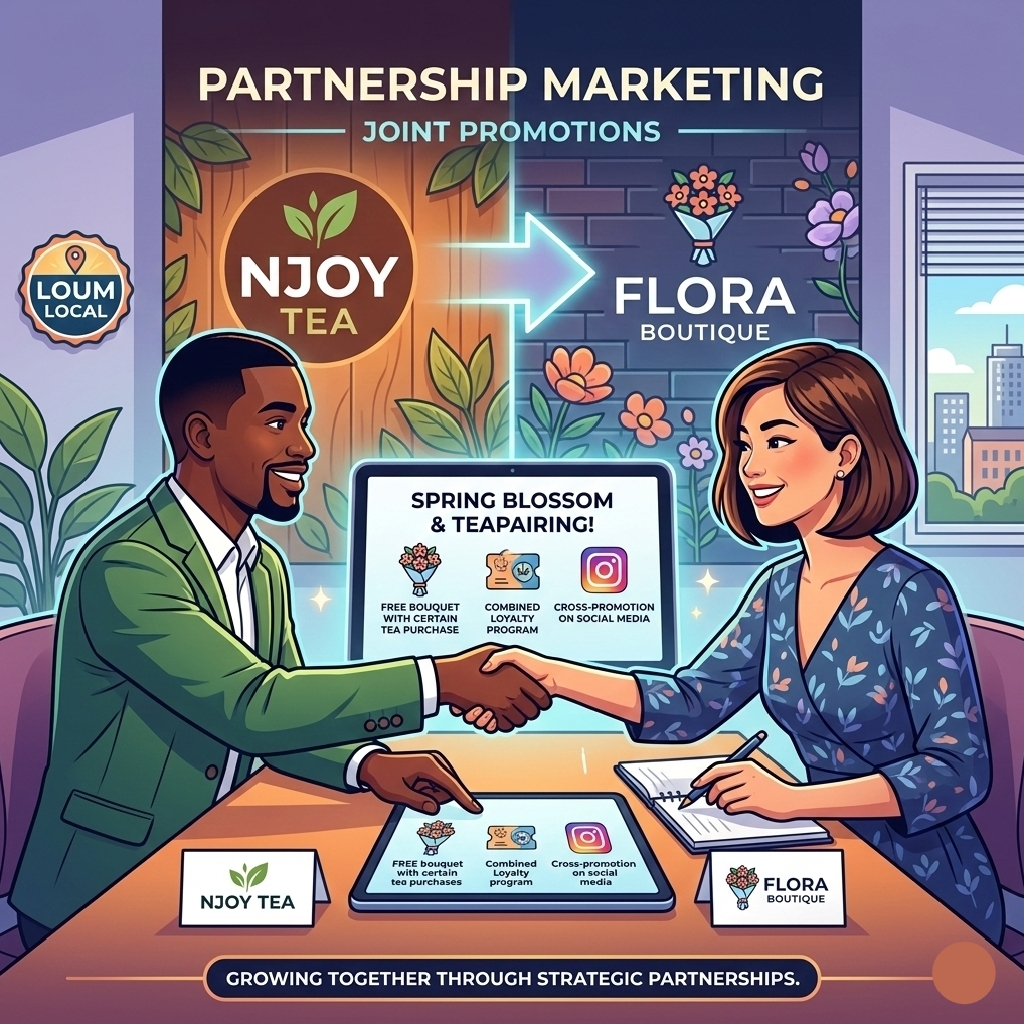
The “Holy Trinity” for 2026 is Organic Social, Cold Email, and Local Partnerships. According to research from Demand Gen Report, 74% of companies say that partnerships are a primary driver of new customer acquisition. Find a business that has your customers but doesn’t compete with you, and offer to provide value to their audience.
Conclusion: Taking Action Today
I want to leave you with one final thought: Success in learning how to launch a small business isn’t about being the smartest person in the room. It’s about being the most persistent. I’ve seen people with “average” ideas build massive brands because they simply refused to stop at Customer #3.
At INSPIRED TO PROSPER, my mission is to give you the knowledge, but the “Prosper” part is up to you. You now have the entrepreneurship tips for new businesses, the case studies, and the 30-day roadmap. Don’t let this be another tab you close and forget.
Go back to Week 1. Build that landing page. Send that first awkward email. If you find yourself stuck, refer back to my 9 small business growth strategies for beginners to get your mindset right. The world doesn’t need another “thinker,” it needs a “doer.”
Go get your first 10. I’ll be right here cheering you on.