


HOW TO START AN E-COMMERCE BUSINESS IN 2026 (STEP-BY-STEP FOR BEGINNERS)
INTRODUCTION: WHY E-COMMERCE IS STILL A BIG OPPORTUNITY IN 2026
Learning how to start an e-commerce business in 2026 has become one of the biggest opportunities for beginners looking to build income online.
And honestly, despite increasing competition, e-commerce is still growing rapidly because more people continue shifting toward online shopping every year.
Today, customers buy almost everything online:
- fashion products
- electronics
- skincare
- digital products
- home essentials
- educational resources
- even local services
This is why many people are now exploring an e-commerce business as a realistic path to building income with relatively low startup costs compared to traditional businesses.
But at the same time, starting can feel overwhelming.
Many beginners struggle with questions like:
- What product should I sell?
- Do I need a lot of money?
- Which platform should I use?
- What if nobody buys?
- How do I actually get customers?
And honestly, these fears are completely normal.
One thing I’ve observed repeatedly is that many people delay starting because they believe e-commerce is too complicated or too expensive.
But the truth is, modern tools have made it easier than ever to launch an online store, even with limited experience or budget.
Platforms like Shopify,WooCommerce, and Etsy now allow beginners to build stores much faster than before.
The real challenge is not simply launching a store.
It is building a business that can actually generate consistent sales over time.
That’s exactly what this guide is designed to help you understand.
Instead of giving generic advice, this article will walk you through:
- Choosing profitable products
- Setting up your online store
- Avoiding beginner mistakes
- Building customer trust
- Using practical e-commerce marketing strategies
- Getting your first sales realistically
And most importantly, we’ll simplify the process step-by-step so you can focus on execution instead of confusion.
Because in 2026, the businesses growing fastest are not always the ones with the biggest budgets.
They are usually the ones willing to learn, adapt, market consistently, and build systems gradually over time.
WHAT IS AN E-COMMERCE BUSINESS AND HOW DOES IT WORK?

Before learning the technical side of how to start an online store, it’s important to first understand what an e-commerce business actually is.
In simple terms, an e-commerce business is any business that sells products or services online.
Instead of customers walking into a physical shop, they browse products digitally through a website, social media page, or online marketplace, then complete purchases electronically.
This means businesses can now reach customers far beyond their local area using the internet alone.
And honestly, this is one reason e-commerce continues growing so fast globally.
How an E-Commerce Business Makes Money
The basic process is simple:
- A customer discovers your product online
- They place an order through your store
- Payment is processed digitally
- The product is delivered physically or digitally
- You keep the profit after expenses
That’s the foundation behind most online stores today.
But the way products are sourced and delivered can vary depending on the business model you choose.
Different Types of E-Commerce Business Models
One thing many beginners don’t realize is that there are several ways to run an e-commerce business.
You do not necessarily need a warehouse full of products to get started.
Here are some of the most common models beginners use in 2026.
1. Dropshipping
Dropshipping is one of the most popular forms of low-cost e-commerce business models for beginners.
With dropshipping:
- You create the online store
- Customers place orders
- A supplier ships the products directly to the customer
This means you do not physically store inventory yourself.
Platforms like AliExpress and Zendrop are commonly used for sourcing dropshipping products.
The advantage is a lower startup cost.
The downside is lower control over shipping speed and product quality.
2. Inventory-Based E-Commerce
This model involves buying or producing products upfront and storing inventory yourself.
Examples include:
- fashion brands
- skincare businesses
- electronics stores
- local product businesses
This model offers better control over branding, packaging, and customer experience.
But it usually requires more startup capital and inventory management.
3. Print-on-Demand
Print-on-demand businesses sell custom-designed products like:
- T-shirts
- mugs
- hoodies
- phone cases
- notebooks
Products are only printed after customers order them.
Platforms like Printify and Printful simplify this process for beginners.
This model works well for creators, niche communities, and personal brands.
4. Digital Products
Digital products are becoming one of the fastest-growing e-commerce business ideas because there is no physical shipping involved.
Examples include:
- eBooks
- templates
- online courses
- digital planners
- software tools
- graphic assets
Once created, digital products can often be sold repeatedly with very low ongoing costs.
Platforms like Gumroad and Payhip are commonly used for selling digital products online.
How Customers Find Online Stores
One major misconception many beginners have is that simply launching a store automatically brings customers.
But real growth usually depends heavily on marketing and visibility.
Most successful stores attract traffic using:
- social media content
- SEO
- Pinterest marketing
- email marketing
- influencer collaborations
- paid advertising
- blogging
This is why understanding e-commerce marketing strategies becomes extremely important after setup.
Because without visibility, even strong products struggle to generate sales.
E-Commerce Is More Than Just Selling Products
One thing I’ve consistently observed is that successful online stores usually operate like complete brands, not just random product pages.
They focus heavily on:
- customer trust
- branding
- product positioning
- user experience
- long-term customer relationships
And honestly, this is where many beginners underestimate the business side of e-commerce.
The stores growing consistently in 2026 are usually the ones building systems around marketing, trust, and customer experience instead of chasing shortcuts alone.
WHY MOST BEGINNERS FAIL BEFORE THEIR E-COMMERCE BUSINESS GROWS
One thing I’ve noticed after studying many struggling online stores is this:
Most beginners do not fail because e-commerce is “dead.”
They fail because they enter the business with unrealistic expectations and weak systems.
And honestly, social media has made this problem even worse.
Many people see viral success stories showing huge sales screenshots and luxury lifestyles, then assume launching an online store automatically leads to fast money.
But real e-commerce growth usually looks very different behind the scenes.
It often involves:
- testing products
- learning marketing
- improving conversion rates
- building customer trust
- fixing mistakes gradually over time
This is why many beginners quit before their business even has time to grow properly.
Choosing the Wrong Products
One of the biggest reasons beginners struggle is poor product selection.
A lot of people choose products based only on hype or trends without researching actual demand.
They see a product going viral online and immediately rush to sell it without asking:
- Is there consistent demand?
- Is the market already saturated?
- Does this solve a real problem?
- Can I market this effectively?
This creates a situation where stores launch products that customers are not strongly interested in buying long-term.
And honestly, product research is one of the most important parts of how to start an e-commerce business successfully.
No Clear Marketing Strategy
Another major mistake is assuming customers will magically appear after launching the store.
Many beginners spend weeks building their website, but almost no time learning how to drive traffic.
The truth is:
An online store without marketing is like opening a shop in the middle of nowhere.
Without visibility, people simply won’t discover your products.
This is why successful stores invest heavily in:
- content marketing
- SEO
- social media growth
- email marketing
- influencer partnerships
Instead of focusing only on design.
If you want to understand this deeper, revisit How to Market Your Small Business in 2026 Without Wasting a Kobo on Ads because the same principles apply strongly to e-commerce businesses too.
Unrealistic Expectations Destroy Motivation
One thing that hurts many beginners emotionally is expecting immediate results.
Some people launch a store and expect consistent sales within days.
So when growth feels slow at first, discouragement builds quickly.
But most successful online businesses needed time to improve:
- branding
- offers
- product positioning
- traffic systems
- customer trust
E-commerce is usually a long-term skill-building process, not an overnight shortcut.
Copying Trends Blindly
Another major issue is blindly copying competitors or viral stores.
A lot of beginners build stores around whatever trend is popular without understanding:
- customer psychology
- branding
- audience targeting
- long-term sustainability
This often leads to stores that feel generic and forgettable.
And honestly, competition becomes much harder when there’s no clear uniqueness behind the business.
Giving Up Too Early
One thing I’ve consistently observed is that many stores quit right before they start learning what actually works.
The early stage of e-commerce often involves trial and error.
You may need to:
- test products
- improve your content
- optimize product pages
- adjust pricing
- strengthen marketing
before momentum begins building.
This is normal.
The businesses that survive usually treat mistakes as learning opportunities instead of proof that they should stop completely.
Strong Businesses Focus on Systems
Successful e-commerce brands rarely rely on luck alone.
They build systems around:
- customer acquisition
- trust-building
- conversion optimization
- retention
- content marketing
This is why understanding growth systems matters so much.
For example, the principles discussed in Sales System for a Small Business: Stop Chasing Leads, Build a Predictable Machine in 2026 apply strongly to online stores too.
Because businesses that rely only on random sales usually struggle long-term.
The Key Insight
Most beginner failures are not caused by a lack of opportunity.
They are usually caused by:
- poor preparation
- weak marketing
- unrealistic expectations
- lack of patience
- inconsistent execution
And honestly, avoiding these mistakes already gives beginners a much stronger chance of building a successful e-commerce business in 2026.
STEP 1: CHOOSE A PROFITABLE E-COMMERCE BUSINESS IDEA

One of the most important parts of how to start an e-commerce business successfully is choosing the right product or niche from the beginning.
And honestly, this is where many beginners either build momentum or create problems for themselves early.
A weak product idea makes marketing harder.
A strong product idea makes growth easier.
This does not mean you need a “perfect” product before starting.
But you do need something with:
- real demand
- clear customer interest
- market potential
- room for consistent sales
Because even the best marketing struggles when the product itself solves no meaningful problem.
Stop Chasing Trends Blindly
One mistake many beginners make is choosing products only because they are trending on social media.
They see viral videos or sudden hype and immediately rush to open stores around the same products.
The problem is that trends move quickly.
By the time many beginners enter the market:
- The competition is already high
- ad costs increase
- customer excitement drops
This creates unstable businesses that disappear once the trend fades.
Instead of chasing hype alone, focus on products that solve real customer problems or improve people’s lives in some way.
Those types of products usually survive longer and market more easily.
Focus on Problem-Solving Products
The strongest e-commerce business ideas usually fall into one or more of these categories:
- saving time
- solving frustration
- improving convenience
- improving appearance
- helping productivity
- supporting hobbies or passions
For example:
- Skincare products solve confidence concerns
- Organizers solve clutter problems
- fitness products support health goals
- Educational products improve learning
- Pet products support emotional connection
When products connect to strong emotions or practical needs, customers buy more consistently.
Evergreen Products vs Trending Products
Understanding the difference between evergreen and trending products is extremely important for beginners.
Evergreen Products
These are products people consistently buy year-round.
Examples include:
- beauty products
- fitness accessories
- home organization products
- baby products
- pet supplies
- educational tools
Evergreen niches often provide more stable long-term growth opportunities.
Trending Products
These products experience sudden spikes in popularity but may decline quickly later.
Examples include:
- viral gadgets
- meme products
- short-term TikTok trends
Trending products can generate fast sales temporarily, but they usually carry higher risk.
For beginners, combining stable evergreen demand with trend awareness is often a smarter strategy.
Use Product Demand Research Before Launching
One thing many beginners skip completely is market research.
But honestly, researching demand early can save huge amounts of time and money later.
You want evidence that people are already searching for products similar to what you plan to sell.
Useful tools include:
These platforms help identify:
- rising demand
- customer interests
- seasonal trends
- competitive opportunities
Validate Product Ideas Cheaply First
One thing I strongly recommend for beginners is validating ideas before investing heavily.
Instead of buying a large inventory immediately, test interest first using:
- social media content
- simple landing pages
- polls and surveys
- pre-orders
- small advertising tests
This helps reduce risk while learning what customers actually respond to.
Many successful businesses started with small product tests before scaling up.
Profitable E-Commerce Niches in 2026
Some of the strongest niches showing continued growth include:
Health and Wellness
- fitness accessories
- supplements
- self-care products
Home and Lifestyle
- home decor
- organization tools
- kitchen gadgets
Digital Products
- templates
- online courses
- planners
- business resources
Personal Branding and Creator Products
- merchandise
- educational products
- niche communities
Sustainable Products
- eco-friendly alternatives
- reusable products
- ethical brands
Pet Industry
- pet accessories
- pet grooming
- pet wellness products
These niches continue growing because they connect to long-term consumer behavior, not just temporary hype.
Passion Alone Is Not Enough
A lot of beginners choose products based only on personal passion.
Passion helps with consistency, but demand matters even more.
The best opportunities usually exist where:
- customer demand
- profitability
- personal interest
overlap together.
Because a product nobody wants becomes difficult to sustain no matter how passionate the owner feels about it.
Competition Is Not Always Bad
One thing many beginners fear is entering competitive markets.
But competition often proves there is strong demand.
The real goal is not avoiding competition completely.
It is finding ways to position your brand differently through:
- branding
- customer experience
- content
- niche targeting
- product presentation
This creates stronger long-term opportunities even inside competitive spaces.
The Key Insight
Choosing the right product idea is not about luck.
It’s about understanding customer demand, solving real problems, and validating opportunities strategically before scaling aggressively.
And honestly, beginners who learn product research early already avoid one of the biggest reasons many e-commerce businesses fail.
STEP 2: PICK THE RIGHT E-COMMERCE BUSINESS MODEL

After choosing a product idea, the next important step in starting an e-commerce business is selecting the right business model.
And honestly, this decision affects almost everything later:
- startup costs
- profit margins
- risk level
- delivery systems
- customer experience
- scalability
One thing many beginners do wrong is copying business models they see online without understanding whether those models actually fit their situation.
But the smartest approach is choosing a model that matches your:
- budget
- skills
- available time
- risk tolerance
- long-term goals
Because not every e-commerce model works the same way.
1. DROPSHIPPING
Dropshipping remains one of the most popular options for an e-commerce business for beginners because it allows people to start with relatively low upfront costs.
With dropshipping:
- You create the store
- Customers place orders
- Suppliers handle storage and shipping
You never physically keep the products yourself.
Popular supplier platforms include:
Advantages of Dropshipping
- Lower startup costs
- No inventory storage
- Easier to test products
- Lower financial risk initially
- Flexible product selection
This makes dropshipping attractive for beginners with limited capital.
Challenges of Dropshipping
However, dropshipping also comes with challenges:
- lower profit margins
- shipping delays
- supplier quality issues
- less branding control
- higher competition
And honestly, many beginners underestimate how important customer experience is in dropshipping businesses.
2. INVENTORY-BASED E-COMMERCE
This model involves purchasing or producing products upfront and managing inventory yourself.
Examples include:
- fashion brands
- cosmetic businesses
- local product stores
- electronics stores
You handle:
- inventory
- packaging
- fulfillment
- shipping processes
either personally or through fulfillment partners.
Advantages of Holding Inventory
- Higher profit margins
- Better branding control
- Faster shipping options
- Stronger customer experience
- Easier quality control
This model often creates stronger long-term brand opportunities.
Challenges of Holding Inventory
The main downside is the higher startup cost.
You may need money for:
- inventory
- packaging
- storage
- shipping materials
There’s also more risk if products do not sell quickly.
But honestly, many successful brands eventually move toward this model because it gives greater business control.
3. PRINT-ON-DEMAND
Print-on-demand has become one of the fastest-growing low-cost e-commerce business models for creators and niche brands.
With this model, products are printed only after customers place orders.
Popular products include:
- T-shirts
- hoodies
- mugs
- posters
- phone cases
Platforms like:
handle production and shipping automatically.
Advantages of Print-on-Demand
- Very low startup cost
- No inventory management
- Easy customization
- Strong niche branding opportunities
This works especially well for creators building communities online.
Challenges of Print-on-Demand
- Lower profit margins
- High competition
- Requires strong branding and design
- Product quality can vary between suppliers
Success usually depends heavily on content, audience-building, and unique branding.
4. DIGITAL PRODUCTS
Digital products are becoming extremely attractive because they avoid physical shipping entirely.
Examples include:
- eBooks
- online courses
- templates
- digital planners
- design assets
- business resources
Platforms like:
allow creators to sell digital products globally.
Advantages of Digital Products
- Very high profit margins
- No shipping costs
- Easy scalability
- Global customer reach
- Automated delivery
Once created, digital products can often generate ongoing income repeatedly.
Challenges of Digital Products
- Requires valuable knowledge or skills
- High competition in some niches
- Strong marketing needed
- Trust-building is important
And honestly, content marketing becomes extremely important for digital product businesses.
WHICH MODEL IS BEST FOR BEGINNERS?
There is no universal “perfect” model.
The best choice depends on your situation.
Dropshipping May Work Best If:
- You have very limited capital
- You want to test products quickly
- You prefer lower upfront risk
Inventory-Based Stores May Work Best If:
- You want stronger branding
- You care about customer experience
- You can invest more upfront
Print-on-Demand May Work Best If:
- You enjoy content creation
- You have niche audience ideas
- You want low inventory risk
Digital Products May Work Best If:
- You have valuable knowledge or skills
- You prefer a scalable online income
- You want high margins
Focus on Simplicity First
One mistake many beginners make is trying to build overly complicated businesses immediately.
But honestly, simplicity often creates faster learning.
Start with a model you can realistically manage while learning the basics of:
- marketing
- customer service
- conversion optimization
- content creation
- traffic generation
Because the real growth usually comes from improving systems gradually over time.
The Key Insight
The right e-commerce business model is not the one that looks most exciting online.
It’s the one that realistically fits your resources, strengths, and long-term goals while allowing you to grow sustainably.
STEP 3: BUILD YOUR ONLINE STORE THE RIGHT WAY

After choosing your product and business model, the next step in how to start an online store is building the actual store itself.
And honestly, this is where many beginners spend too much time focusing on appearance while ignoring customer experience and conversion strategy.
A successful online store is not just about looking beautiful.
It should also feel:
- trustworthy
- easy to navigate
- mobile-friendly
- fast-loading
- simple to buy from
Because even strong products struggle when the shopping experience feels confusing or unprofessional.
SHOPIFY VS WOOCOMMERCE: WHICH IS BETTER FOR BEGINNERS?
Two of the most popular platforms for beginners are:
Both are powerful, but they work differently.
Shopify
Shopify is one of the easiest platforms for beginners because it handles most technical setup automatically.
With Shopify, you get:
- hosting
- security
- payment integrations
- store templates
- built-in tools
all inside one system.
This makes it easier for beginners who want simplicity and a faster setup.
Shopify Advantages
- beginner-friendly
- fast setup
- reliable security
- mobile optimization
- easy integrations
Shopify Challenges
- monthly subscription fees
- limited customization compared to WordPress
- Some advanced apps cost extra
WooCommerce
WooCommerce works through WordPress and offers more flexibility and customization.
This option works well for people who want greater control over their website and SEO.
WooCommerce Advantages
- greater customization
- strong SEO capabilities
- lower long-term costs
- full ownership control
WooCommerce Challenges
- steeper learning curve
- requires hosting setup
- more technical maintenance
And honestly, since you’re already working with WordPress, WooCommerce may eventually become a strong long-term option if you continue learning website management gradually.
CHOOSE A SIMPLE DOMAIN NAME
Your domain name is your store’s online identity.
Good domain names are usually:
- simple
- easy to spell
- memorable
- brand-friendly
Avoid names that are:
- too long
- confusing
- difficult to pronounce
- filled with unnecessary numbers or symbols
You can buy domains from platforms like:
PRIORITIZE MOBILE-FRIENDLY DESIGN
One thing many beginners underestimate is how important mobile optimization has become.
Most online shopping now happens on smartphones.
That means your store must look clean and easy to use on mobile devices.
Your store should have:
- readable text
- fast loading speed
- clean navigation
- visible buttons
- simple checkout process
Poor mobile experience is one of the biggest reasons visitors leave stores without buying.
And honestly, this is why responsive design matters more than fancy animations.
KEEP YOUR STORE DESIGN CLEAN AND SIMPLE
A common beginner mistake is overcrowding the website with:
- excessive colors
- too many popups
- cluttered layouts
- confusing menus
But the highest-converting stores are often surprisingly simple.
Focus on:
- clean product presentation
- professional branding
- easy navigation
- strong product visuals
Your goal is to make customers feel comfortable and confident while shopping.
BUILD BASIC BRANDING ELEMENTS
Strong branding helps stores feel more professional and trustworthy.
Even as a beginner, try to create consistency across:
- colors
- fonts
- logo style
- product images
- tone of communication
You do not need expensive branding immediately.
But consistency creates a more serious business appearance.
IMPORTANT PAGES EVERY ONLINE STORE NEEDS
Many beginners skip essential pages that build customer trust.
At a minimum, your store should include:
About Page
Tell customers:
- who you are
- What your brand stands for
- Why the business exists
This helps humanize the business.
Contact Page
Provide:
- email address
- support information
- social media links
Customers feel safer when businesses are easy to contact.
Shipping Policy
Clearly explain:
- delivery timelines
- shipping costs
- international availability
Transparency reduces customer frustration later.
Return and Refund Policy
Customers want reassurance before buying.
Clear return policies improve trust and reduce purchase hesitation.
Privacy Policy and Terms
These pages help your store appear more professional and compliant.
Platforms like Termly can help generate basic legal policy templates for beginners.
PAYMENT GATEWAYS MATTER
Your store needs secure payment systems that customers recognize and trust.
Popular payment gateways include:
Secure checkout systems increase customer confidence significantly.
SPEED MATTERS MORE THAN MOST BEGINNERS THINK
A slow website quietly kills conversions.
Customers today expect fast-loading stores.
If pages load slowly, many visitors leave before even viewing products properly.
You can improve speed by:
- compressing images
- avoiding heavy animations
- using lightweight themes
- improving hosting quality
Tools like Google PageSpeed Insights help analyze store performance.
FOCUS ON TRUST, NOT PERFECTION
One thing I’ve repeatedly observed is that beginners often delay launching because they want everything perfect first.
But honestly, most successful stores improved gradually after launch.
The real goal is building a store that feels:
- trustworthy
- functional
- easy to use
- professional enough to support sales
Perfection is not required immediately.
Progress and improvement matter far more early on.
The Key Insight
A successful online store is not built only for aesthetics.
It is built to create trust, improve customer experience, and guide visitors smoothly toward making purchases.
STEP 4: CREATE PRODUCT PAGES THAT CONVERT VISITORS INTO BUYERS

One of the biggest mistakes beginners make when learning how to start an e-commerce business is assuming traffic alone creates sales.
But honestly, traffic is only part of the equation.
Your product pages are what actually convince visitors to trust your store and buy.
And this is where many online stores quietly lose customers every single day.
A weak product page creates hesitation.
A strong product page creates confidence and clarity.
The goal is to help visitors quickly understand:
- What the product does
- Why it matters
- How does it improve their life
- Why they should trust your store
Because customers rarely buy products based only on features.
They buy based on perceived value and emotional connection.
USE HIGH-QUALITY PRODUCT IMAGES
Your product images are often the first thing customers notice.
Low-quality visuals instantly reduce trust.
And honestly, in e-commerce, visuals heavily influence buying decisions because customers cannot physically touch the products themselves.
Strong product images should:
- Look clean and professional
- Show multiple angles
- Demonstrate product usage
- Highlight important details
- Feel visually consistent across the store
Lifestyle images also help customers imagine themselves using the product.
For example:
- fitness products shown during workouts
- skincare products shown in routines
- home decor displayed inside beautiful spaces
This improves emotional connection significantly.
Tools like Canva can help beginners improve product visuals without expensive software.
WRITE BENEFIT-DRIVEN PRODUCT DESCRIPTIONS
One thing I consistently observe is that many beginners write descriptions that sound generic and boring.
They simply list product features without explaining why customers should care.
For example:
Weak description:
“Water bottle made with stainless steel.”
Stronger description:
“Keep your drinks cold for hours while staying hydrated throughout busy workdays, workouts, or travel.”
Notice the difference.
The second version focuses on the customer’s experience and outcome, not just the product itself.
Strong product descriptions should explain:
- benefits
- solutions
- convenience
- emotional outcomes
- practical value
This is one of the most important online store conversion tips beginners should learn early.
USE CLEAR AND SIMPLE FORMATTING
Large blocks of text often overwhelm customers.
Instead, make product pages easier to scan using:
- bullet points
- short paragraphs
- spacing
- clear headings
Most online shoppers skim before deciding whether to continue reading.
Simple formatting improves readability and keeps visitors engaged longer.
PRICE PRODUCTS STRATEGICALLY
Pricing affects both sales and customer perception.
One mistake many beginners make is underpricing products out of fear that nobody will buy.
But extremely low prices sometimes reduce trust because customers associate cheap pricing with poor quality.
At the same time, pricing too high without strong branding also creates resistance.
Good pricing usually considers:
- product quality
- competitor pricing
- shipping costs
- target audience
- profit margins
- perceived value
And honestly, customers often pay more when stores position products professionally and communicate value clearly.
ADD TRUST ELEMENTS TO PRODUCT PAGES
Trust is one of the biggest factors influencing online sales.
Customers naturally feel cautious when buying from unfamiliar stores.
Strong product pages reduce that hesitation by using:
- customer reviews
- testimonials
- secure payment icons
- money-back guarantees
- clear shipping information
- return policies
Even small trust signals can improve conversions significantly.
This is one reason many successful stores focus heavily on credibility and transparency.
OPTIMIZE YOUR CALL-TO-ACTION (CTA)
Your CTA button tells customers what action to take next.
Weak CTAs often create confusion or hesitation.
Strong CTAs feel clear and action-oriented.
Examples include:
- Add to Cart
- Buy Now
- Start Your Order
- Get Yours Today
Your CTA button should also:
- stand out visually
- appear clearly on mobile
- Stay easy to find throughout the product page
MOBILE PRODUCT PAGE EXPERIENCE MATTERS
Most customers now shop from smartphones.
This means your product pages must look clean and function smoothly on smaller screens.
Check for:
- readable text size
- fast image loading
- mobile-friendly layouts
- visible CTA buttons
- easy scrolling
Poor mobile experience silently destroys many sales opportunities.
And honestly, many beginners do not test their stores enough on actual phones before launching.
PRODUCT PAGES SHOULD ANSWER CUSTOMER QUESTIONS
A strong product page reduces uncertainty before customers even contact support.
Helpful sections can include:
- sizing information
- shipping details
- FAQs
- usage instructions
- warranty information
The more clarity customers have, the easier buying decisions become.
SEO ALSO MATTERS FOR PRODUCT PAGES
Optimized product pages help stores attract organic traffic from Google.
Basic SEO improvements include:
- keyword-focused titles
- optimized product descriptions
- image alt text
- clean URLs
- relevant headings
This helps your store appear more discoverable over time.
And honestly, combining SEO with strong product pages creates long-term growth advantages that many beginners overlook.
If you want to understand broader organic marketing systems that support online store growth, revisit How to Market Your Small Business in 2026 Without Wasting a Kobo on Ads because sustainable traffic becomes extremely valuable in e-commerce.
FOCUS ON CUSTOMER CONFIDENCE
At the end of the day, successful product pages are designed to increase customer confidence.
They reduce fear, answer objections, and make purchasing feel easier.
One thing I’ve repeatedly observed is that stores with average products but strong product pages often outperform stores with great products and weak presentation.
Because perception and trust influence online buying heavily.
The Key Insight
Product pages are not just informational pages.
They are sales tools designed to turn visitors into buyers by combining:
- strong visuals
- persuasive messaging
- trust signals
- customer clarity
- smooth user experience
And honestly, learning this skill early gives beginners a major advantage in e-commerce growth.
STEP 5: USE E-COMMERCE MARKETING STRATEGIES TO GET YOUR FIRST SALES

One of the biggest realities beginners discover after launching a store is this:
Building the store is only the beginning.
The real challenge is learning how to get sales for an online store consistently.
And honestly, this is where many new e-commerce businesses struggle most.
A lot of beginners spend weeks designing their website, uploading products, and setting everything up, then become discouraged when traffic and sales do not appear automatically.
But successful e-commerce stores grow because they actively build visibility and customer attention over time.
This is why understanding e-commerce marketing strategies is just as important as choosing products or building the store itself.
Because without traffic, even strong products remain invisible.
USE SOCIAL MEDIA TO BUILD ATTENTION
Social media remains one of the most powerful low-cost marketing tools for beginners in 2026.
Platforms like:
allow businesses to reach customers organically through content.
And honestly, many small brands are now growing faster through content than through paid ads alone.
The key is creating content that either:
- educates
- entertains
- solves problems
- inspires
- demonstrates product value
For example:
- Skincare brands can show routines and results
- Fitness brands can share workout tips
- Home decor stores can post room transformations
- Fashion stores can create styling videos
This helps products feel more connected to real-life usage.
If you want deeper insight into organic marketing systems, revisit:
- How to Market Your Small Business in 2026 Without Wasting a Kobo on Ads
- 7 Instagram Growth Strategies Small Businesses Are Using in 2026
because modern e-commerce growth depends heavily on visibility and audience-building.
CONTENT MARKETING CREATES LONG-TERM TRAFFIC
One thing I’ve consistently observed is that businesses relying only on ads often struggle when advertising costs increase.
But businesses creating content consistently build more sustainable traffic systems over time.
Content marketing can include:
- blog posts
- short-form videos
- Pinterest pins
- tutorials
- product guides
- educational content
This is one reason blogging works so well alongside e-commerce businesses.
For example, if you sell fitness products, you can publish content around:
- workout routines
- weight loss tips
- fitness mistakes
- healthy lifestyle advice
This attracts people already interested in your niche.
And honestly, SEO traffic becomes extremely valuable because it can continue bringing visitors long after the content is published.
LEARN BASIC SEO FOR YOUR STORE
SEO helps your store appear in search results when customers search for products online.
And in 2026, SEO is becoming increasingly important because paid advertising costs continue rising.
Basic SEO improvements include:
- keyword-focused product titles
- optimized blog content
- image alt text
- fast-loading pages
- internal linking
- mobile optimization
Tools like:
It can help beginners understand search traffic opportunities.
And honestly, SEO often compounds over time, making it one of the strongest long-term growth systems for e-commerce businesses.
EMAIL MARKETING IS STILL EXTREMELY POWERFUL
A lot of beginners underestimate email marketing because social media feels more exciting.
But email remains one of the highest-converting marketing channels for online stores.
Why?
Because email gives businesses direct communication access to customers without depending entirely on social media algorithms.
Useful email campaigns include:
- welcome emails
- abandoned cart reminders
- product launches
- discounts
- educational newsletters
- customer retention campaigns
Platforms like:
help automate email systems for beginners.
INFLUENCER COLLABORATIONS CAN ACCELERATE GROWTH
You do not always need huge influencers to market products successfully.
Micro-influencers with smaller but engaged audiences often perform surprisingly well for e-commerce brands.
Especially in niches like:
- beauty
- fitness
- fashion
- tech
- lifestyle
Working with creators helps businesses gain:
- trust
- visibility
- social proof
- audience exposure
And honestly, authentic recommendations often outperform traditional advertising.
PINTEREST IS UNDERRATED FOR E-COMMERCE
One thing many beginners overlook is how powerful Pinterest can be for online stores.
Unlike fast-moving platforms where posts disappear quickly, Pinterest content can continue generating traffic for months.
This works especially well for niches like:
- fashion
- beauty
- business
- home decor
- DIY
- fitness
- digital products
SEO-focused Pinterest pins can drive highly targeted traffic directly to product pages and blog posts.
And honestly, Pinterest works especially well when combined with blogging and SEO.
PAID ADS SHOULD NOT BE YOUR ONLY STRATEGY
Paid advertising can help accelerate traffic, but relying entirely on ads creates risk.
Advertising costs continue increasing across platforms.
This is why smart businesses combine paid traffic with:
- organic content
- SEO
- email marketing
- community building
Long-term growth becomes much more stable this way.
CUSTOMER TRUST AFFECTS MARKETING RESULTS
Even great marketing struggles if customers do not trust the store after visiting.
This is why successful stores focus heavily on:
- reviews
- branding
- customer support
- product quality
- transparency
Marketing gets attention.
Trust converts customers.
Both matter equally.
CONSISTENCY MATTERS MORE THAN VIRALITY
One thing I’ve repeatedly observed is that many businesses chase viral moments while ignoring consistency.
But most sustainable e-commerce growth comes from repeated visibility over time.
Consistent content, marketing, and audience-building usually outperform random bursts of activity.
And honestly, this is where patience becomes extremely important.
YOUR FIRST SALES ARE OFTEN THE HARDEST
The beginning stage usually feels slowest because:
- Your audience is small
- Your store is new
- Trust is still developing
But once systems improve and visibility increases, momentum often becomes easier to build gradually.
This is why learning customer acquisition matters so much early on.
If you want practical strategies for generating early customers, revisit:
First 10 Customers in 30 Days: A Practical Guide for New Small Businesses
because many of those same principles apply strongly to beginner e-commerce brands too.
The Key Insight
Successful e-commerce businesses rarely depend on one marketing tactic alone.
They grow by combining:
- visibility
- trust
- content
- SEO
- customer relationships
- consistent execution
And honestly, beginners who learn marketing early usually build stronger long-term businesses than those relying only on products themselves.
STEP 6: HOW TO GET CUSTOMERS TO TRUST YOUR ONLINE STORE

One of the biggest challenges beginners face when learning how to start an e-commerce business is building trust with customers they’ve never met before.
And honestly, this is completely normal.
When people shop online, they naturally ask themselves questions like:
- Is this store legitimate?
- Will I actually receive my order?
- Is the product quality good?
- What happens if something goes wrong?
If your store does not address these concerns clearly, many visitors leave without buying, even if the product itself is good.
This is why trust-building becomes one of the most important parts of growing an online store successfully.
Because in e-commerce, customers buy confidence just as much as they buy products.
USE CUSTOMER REVIEWS AND TESTIMONIALS
Reviews are one of the strongest trust signals in online shopping.
People naturally feel more comfortable buying when they see evidence that others have already had positive experiences.
This is called social proof.
Good reviews help reduce uncertainty by showing:
- customer satisfaction
- product quality
- delivery success
- real user experiences
Even beginner stores can start collecting reviews early by:
- asking initial customers for feedback
- encouraging photo reviews
- following up after purchases
- offering small incentives for honest reviews
Apps like:
help online stores display customer reviews professionally.
And honestly, visual reviews with customer photos often improve trust even more.
OFFER SECURE PAYMENT METHODS
Customers pay close attention to payment security.
If checkout feels unsafe or unfamiliar, many buyers abandon their carts immediately.
Your store should use trusted payment systems like:
Displaying secure checkout badges and SSL protection also improves confidence significantly.
This small detail quietly affects conversion rates more than many beginners realize.
CREATE PROFESSIONAL BRANDING
Professional branding makes stores feel more credible and established.
And honestly, customers often judge businesses within seconds based on visual presentation.
Strong branding includes consistency across:
- logo design
- colors
- typography
- product photography
- communication style
This does not mean beginners need expensive branding immediately.
But even simple, clean consistency creates a stronger customer perception than random, unorganized designs.
RESPOND TO CUSTOMERS QUICKLY
Fast communication builds trust surprisingly fast.
When customers ask questions and receive delayed responses, uncertainty increases.
But responsive businesses feel more reliable and customer-focused.
Try to respond quickly to:
- emails
- social media messages
- order concerns
- shipping questions
And honestly, strong customer support often becomes a competitive advantage for smaller brands.
Many large companies struggle to provide personalized communication.
BE TRANSPARENT ABOUT SHIPPING AND RETURNS
One major reason customers hesitate online is the fear of bad surprises later.
This is why transparency matters so much.
Clearly explain:
- shipping timelines
- delivery costs
- return policies
- refund conditions
- International shipping availability
Hidden information creates frustration and reduces trust.
But transparent stores feel safer and more professional.
SHOW REAL BUSINESS INFORMATION
Customers trust businesses more when they can clearly identify who they are buying from.
Helpful trust signals include:
- About page
- contact information
- business email
- social media presence
- customer service details
Even simple human touches can make stores feel more legitimate and approachable.
USE HIGH-QUALITY PRODUCT VISUALS
Low-quality product images reduce credibility instantly.
Strong visuals help stores feel more serious and trustworthy.
This is why successful stores invest heavily in:
- clean product photography
- consistent branding
- realistic product demonstrations
- professional presentation
Customers associate presentation quality with product quality.
BUILD TRUST THROUGH CONTENT
One thing I’ve consistently observed is that businesses producing helpful content often gain trust faster than stores focused only on selling.
Educational content helps position the brand as helpful instead of purely transactional.
Examples include:
- tutorials
- guides
- product demonstrations
- FAQs
- behind-the-scenes content
This is one reason content marketing works so powerfully for modern e-commerce brands.
And honestly, customers are more likely to buy from businesses they have already learned from regularly.
SOCIAL PROOF EXTENDS BEYOND REVIEWS
Trust can also come from:
- influencer collaborations
- customer-generated content
- social media engagement
- community interaction
- media mentions
Even active comment sections and authentic customer conversations can improve credibility significantly.
TRUST DIRECTLY IMPACTS SALES
Many beginners focus heavily on traffic but underestimate trust.
But honestly, conversion rates often improve dramatically once stores strengthen credibility.
Because people rarely buy when uncertainty feels too high.
This is why strong stores combine:
- marketing
- customer experience
- trust-building
- transparency
together as one system.
If you want to understand broader customer acquisition systems that support sustainable business growth, revisit:
Sales System for a Small Business: Stop Chasing Leads, Build a Predictable Machine in 2026
because trust and consistency are major parts of long-term customer retention too.
The Key Insight
Customers buy more confidently when stores feel trustworthy, transparent, and professional.
And honestly, many beginner e-commerce stores could improve sales significantly simply by improving customer confidence throughout the buying process.
STEP 7: TRACK WHAT’S WORKING AND IMPROVE YOUR STORE OVER TIME

One thing many beginners misunderstand about how to start an e-commerce business is thinking success comes from launching the store alone.
But honestly, long-term e-commerce growth usually comes from continuous improvement.
The stores growing consistently in 2026 are constantly studying:
- customer behavior
- conversion rates
- traffic sources
- product performance
- marketing results
instead of guessing blindly.
Because without tracking data, it becomes difficult to know:
- What is working
- What is failing
- where sales are leaking
- Which marketing efforts deserve more attention
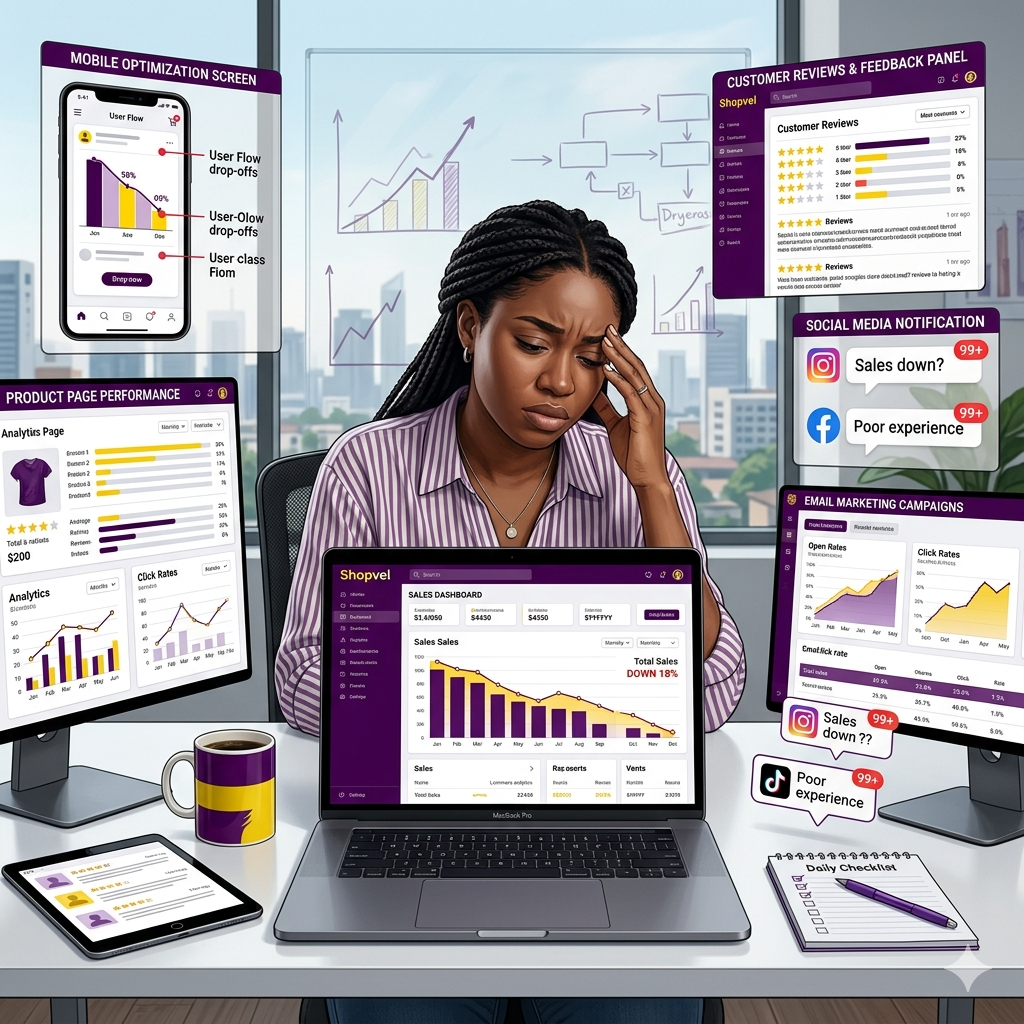
And honestly, many struggling stores are losing money simply because they never analyze their business properly.
UNDERSTANDING BASIC E-COMMERCE ANALYTICS
Analytics simply means tracking how visitors interact with your store.
This helps you make smarter decisions instead of relying only on assumptions.
Important things to monitor include:
- website traffic
- product page views
- conversion rates
- abandoned carts
- traffic sources
- customer behavior
Platforms like:
help store owners understand what customers are actually doing inside the store.
TRACK YOUR CONVERSION RATE
Your conversion rate measures how many visitors actually become buyers.
For example:
- 1,000 visitors
- 20 purchases
equals a 2% conversion rate.
This metric helps reveal whether your store is convincing visitors effectively.
Low conversion rates may signal problems like:
- weak product pages
- poor trust signals
- confusing checkout process
- slow website speed
- weak offers
And honestly, improving conversions is often cheaper than constantly chasing more traffic.
Better conversions help stores make more sales from existing visitors.
PAY ATTENTION TO CUSTOMER BEHAVIOR
One thing successful businesses do well is observe customer patterns carefully.
Ask questions like:
- Which products get the most clicks?
- Where are visitors leaving the website?
- Which pages hold attention longest?
- Which traffic sources convert best?
These insights help improve marketing and store performance gradually over time.
For example:
if customers visit product pages but rarely buy, the issue may involve:
- pricing
- trust
- product descriptions
- checkout friction
Understanding behavior helps stores fix problems strategically.
ANALYZE TRAFFIC SOURCES
Not all traffic performs equally.
Some visitors arrive ready to buy.
Others are only browsing casually.
This is why traffic source analysis matters.
You should track whether visitors come from:
- TikTok
- Google Search
- email marketing
- paid ads
Over time, you’ll notice certain channels generate:
- higher conversions
- better customer quality
- stronger engagement
And honestly, this helps businesses focus energy on the platforms producing real results instead of vanity metrics alone.
ABANDONED CARTS REVEAL IMPORTANT PROBLEMS
A lot of customers add products to carts but leave before completing purchases.
This happens in almost every online store.
Common reasons include:
- unexpected shipping costs
- checkout confusion
- lack of trust
- payment issues
- distractions
Tools like:
allow stores to send abandoned cart reminders automatically.
Recovering even a small percentage of abandoned carts can improve revenue significantly.
IDENTIFY YOUR BEST-SELLING PRODUCTS
Successful stores usually double down on products already performing well.
Instead of spreading attention equally across everything, they focus more marketing energy on winning products.
This can include:
- improving product pages
- creating more content
- running targeted promotions
- expanding related product lines
And honestly, many stores grow faster once they identify and scale their strongest offers.
TEST AND IMPROVE CONTINUOUSLY
E-commerce growth often comes from small improvements over time.
You may need to test:
- product titles
- pricing
- product photos
- CTA buttons
- checkout layouts
- email campaigns
Even small adjustments can increase conversions gradually.
And honestly, successful stores rarely stop optimizing.
DON’T MAKE DECISIONS BASED ONLY ON EMOTION
One thing beginners sometimes do is panic too quickly when results feel slow.
But data helps separate emotions from reality.
For example:
- Traffic may actually be growing
- Customer retention may be improving
- One product may already be gaining momentum
Tracking numbers helps businesses make calmer and smarter decisions long-term.
LONG-TERM GROWTH COMES FROM LEARNING
The most successful e-commerce businesses treat their stores like ongoing learning systems.
They observe:
- customer behavior
- market changes
- product trends
- marketing performance
Then adjust gradually.
And honestly, this mindset creates stronger businesses than simply chasing quick wins.
The Key Insight
E-commerce success is rarely built through guessing alone.
The stores growing consistently are usually the ones tracking data, understanding customer behavior, and improving their systems continuously over time.
COMMON E-COMMERCE MISTAKES BEGINNERS SHOULD AVOID

One thing I’ve consistently observed about beginner e-commerce businesses is this:
Most stores do not fail because the opportunity is bad.
They fail because small mistakes compound over time.
And honestly, many of these mistakes are avoidable once you understand them early.
The problem is that beginners often focus heavily on excitement while overlooking the systems required to build sustainable growth.
This is why learning from common mistakes can save both money and frustration later.
SPENDING TOO MUCH TOO EARLY
A lot of beginners believe they need huge investments before starting.
So they overspend on:
- expensive logos
- premium themes
- unnecessary apps
- large inventory
- paid ads too early
before even validating whether customers actually want the products.
And honestly, this creates unnecessary financial pressure.
The smarter approach is starting lean while testing demand first.
Many successful stores began very simply before scaling gradually over time.
Focus your early budget on things that directly improve:
- customer experience
- marketing
- product validation
- store functionality
instead of vanity upgrades.
IGNORING MOBILE OPTIMIZATION
Most online shopping now happens through smartphones.
Yet many beginners still build stores mainly for desktop users.
This creates frustrating mobile experiences like:
- tiny text
- slow loading pages
- broken layouts
- difficult checkout processes
And honestly, poor mobile optimization silently kills many sales opportunities.
Always test your store carefully on mobile devices before launching.
Check whether customers can:
- browse products easily
- read descriptions comfortably
- navigate smoothly
- complete checkout quickly
Simple mobile experiences usually convert better than overly complicated designs.
WEAK MARKETING STRATEGY
One of the biggest beginner e-commerce mistakes is believing products alone generate sales.
But visibility matters just as much as product quality.
A store without marketing is almost invisible online.
Many beginners launch stores but fail to consistently:
- create content
- build traffic
- grow audiences
- improve SEO
- engage customers
And honestly, marketing is not something businesses do only after launching.
It should already be part of the growth strategy from the beginning.
This is why businesses use:
- content marketing
- SEO
- email marketing
often build stronger long-term growth systems over time.
GIVING UP TOO FAST
One thing social media has distorted heavily is expectations around speed.
A lot of beginners expect fast results within days or weeks.
So when sales feel slow initially, discouragement builds quickly.
But real e-commerce growth usually involves:
- testing
- learning
- improving
- adapting
before momentum starts building consistently.
Most successful stores improved gradually over time, not overnight.
And honestly, consistency often matters more than early perfection.
POOR CUSTOMER SUPPORT
Customer experience plays a huge role in long-term growth.
Yet many beginners underestimate how important communication becomes in e-commerce.
Slow responses, unclear policies, or poor support create distrust quickly.
Strong stores usually prioritize:
- fast communication
- clear policies
- professional responses
- customer satisfaction
Because satisfied customers often become repeat customers and recommend the brand to others.
COPYING COMPETITORS BLINDLY
Another mistake beginners make is copying other stores without understanding the strategy.
They duplicate:
- product pages
- designs
- marketing styles
- offers
without building a unique positioning.
But honestly, successful brands usually stand out because they create their own identity and customer experience.
Learning from competitors is smart.
Blind copying usually weakens originality and long-term branding.
IGNORING TRUST SIGNALS
Many beginners focus heavily on attracting traffic but neglect customer trust.
Missing trust elements like:
- reviews
- secure payment systems
- clear return policies
- professional branding
can reduce conversions significantly.
Customers need reassurance before buying from unfamiliar stores.
And honestly, trust-building often matters just as much as marketing itself.
CHASING TOO MANY PRODUCTS AT ONCE
Some beginners overload their stores with random products immediately.
This often creates confusing branding and weak product positioning.
Focused stores usually perform better because customers understand:
- What the brand represents
- Who the products serve
- Why the store exists
Clarity improves trust and marketing effectiveness.
EXPECTING ADS TO SOLVE EVERYTHING
Paid advertising can help accelerate growth, but many beginners depend entirely on ads too early.
This becomes risky because advertising costs continue increasing.
Businesses relying only on paid traffic often struggle once ad performance drops.
This is why combining ads with:
- SEO
- content marketing
- email marketing
- organic social growth
creates more stable long-term systems.
The Key Insight
Most beginner mistakes are not fatal individually.
But when combined, they slowly weaken growth over time.
And honestly, businesses that stay patient, improve consistently, and focus on customer experience usually build far stronger e-commerce foundations long-term.
FREQUENTLY ASKED QUESTIONS ABOUT STARTING AN E-COMMERCE BUSINESS
How Much Money Do I Need to Start an E-Commerce Business?
One of the biggest beginner fears around how to start an e-commerce business is the startup cost.
And honestly, the amount you need depends heavily on the business model you choose.
For example:
Low-Cost Beginner Setup
If you start with:
- dropshipping
- print-on-demand
- digital products
You can often begin with relatively small budgets focused mainly on:
- domain registration
- store setup
- basic branding
- marketing
Some beginners even start with under $100 while learning gradually.
Higher-Cost Models
Inventory-based businesses usually require more upfront investment because you may need money for:
- inventory
- packaging
- shipping
- storage
The important thing is starting within your realistic financial capacity instead of overspending early.
And honestly, many successful businesses started small before scaling gradually over time.
What Is the Best Platform for Beginners?
The answer depends on your goals and technical comfort level.
Shopify
Shopify is often best for beginners who want simplicity and a faster setup.
It handles:
- hosting
- security
- payments
- store infrastructure
inside one platform.
WooCommerce
WooCommerce works well for people who want more flexibility and stronger long-term website control through WordPress.
It usually requires more learning but offers greater customization.
And honestly, both platforms can work extremely well when used properly.
The best option is often the one you can realistically manage consistently.
Can I Start an E-Commerce Business Without Inventory?
Yes.
This is one reason e-commerce has become more accessible in recent years.
Business models like:
- dropshipping
- print-on-demand
- digital products
allow beginners to sell products without storing inventory physically.
This reduces upfront risk significantly.
However, inventory-free businesses still require:
- marketing
- customer service
- branding
- traffic generation
And honestly, some beginners mistakenly think “no inventory” means “easy money.”
But building visibility and customer trust still requires real effort.
How Long Does It Take to Get Sales?
This varies heavily depending on factors like:
- product demand
- marketing quality
- competition
- traffic sources
- customer trust
Some stores get early sales quickly.
Others take longer to gain momentum.
One thing I’ve consistently observed is that businesses producing consistent content and marketing usually improve faster over time.
But expecting instant success often creates unnecessary frustration.
E-commerce growth usually involves:
- testing
- learning
- optimization
- consistency
before strong momentum develops.
Is Dropshipping Still Worth It in 2026?
Yes, but it is far more competitive now.
The days of launching random generic products and expecting easy profits are fading.
Successful dropshipping businesses today usually focus heavily on:
- branding
- customer experience
- niche targeting
- content marketing
- trust-building
And honestly, strong marketing matters far more now than simply finding a “winning product.”
What Products Are Best for Beginners?
Beginners often do better with products that:
- solve practical problems
- connect to strong interests
- have ongoing demand
- They are easy to market visually
Popular niches include:
- fitness
- beauty
- home organization
- pets
- digital products
- productivity tools
The key is validating demand before investing heavily.
Do I Need Paid Ads to Succeed?
No.
Paid advertising can help accelerate growth, but many businesses now grow through:
- SEO
- Pinterest marketing
- TikTok content
- Instagram Reels
- blogging
- email marketing
And honestly, organic traffic systems often become more sustainable long-term because they reduce dependence on rising ad costs.
Is E-Commerce Too Competitive in 2026?
Competition has definitely increased.
But so has online shopping demand.
And honestly, businesses still succeed every day because customers continue buying online constantly.
The stores growing strongest today usually focus on:
- branding
- customer experience
- trust
- content
- niche positioning
instead of competing only on price alone.
Can I Run an E-Commerce Business Part-Time?
Yes.
Many people begin e-commerce businesses while still working jobs or managing other responsibilities.
This is one reason online businesses attract so many beginners.
However, consistency still matters.
Even part-time businesses need regular effort in areas like:
- content creation
- customer support
- product updates
- marketing
Over time, systems and automation can make management easier.
The Key Insight
Starting an e-commerce business feels overwhelming, especially when beginners try to understand everything at once.
But honestly, most successful stores were built gradually through learning, testing, and consistent improvement over time.
FINAL THOUGHTS: START SIMPLE, LEARN FAST, AND GROW CONSISTENTLY
Learning how to start an e-commerce business in 2026 can feel overwhelming at first, especially with how much information exists online today.
There are countless videos, strategies, and opinions telling beginners what they should do.
But honestly, one thing I’ve consistently observed is that successful e-commerce businesses usually grow from steady execution, not endless perfectionism.
Most stores do not become successful overnight.
They improve gradually through:
- testing products
- learning marketing
- understanding customers
- fixing mistakes
- improving systems over time
And this is completely normal.
The businesses that survive long-term are usually the ones willing to stay consistent even when early growth feels slow.
Because in reality, e-commerce rewards patience, adaptability, and continuous learning far more than shortcuts.
One important thing beginners should remember is this:
You do not need the perfect store to begin.
You need a functional store, a clear offer, and the willingness to improve consistently.
Many successful online businesses started with:
- simple branding
- small audiences
- limited budgets
- imperfect websites
But they kept learning and refining their systems gradually.
And honestly, that process matters more than trying to look “big” immediately.
As online competition continues growing, the businesses standing out most in 2026 are usually the ones focusing on:
- customer trust
- valuable content
- strong branding
- consistent marketing
- real customer experience
instead of chasing shortcuts or temporary hype.
So if you’ve been waiting for the “perfect time” to start, this is your reminder that progress usually begins through action, not overthinking.
Start simple.
Learn fast.
Improve consistently.
Because small improvements repeated over time often create the biggest long-term business growth.


Just launched my first e-commerce store using the step-by-step 2026 blueprint from Wisdom Samuel’s guide — it cut through the noise and gave me clarity on niche selection, model choice, and trust-building. What really stood out? The realistic breakdown of *why* beginners fail (not just “how to do it”) and actionable fixes—like validating products cheaply and prioritizing mobile-first design over perfection. If you’re serious about launching in 2026 without burning cash or time, this is the most grounded, beginner-friendly roadmap I’ve found. Highly recommend starting there before touching Shopify.
Just launched my first e-commerce store using the step-by-step 2026 blueprint from Wisdom Samuel’s guide — and it worked. As a total beginner, I skipped the overwhelm and focused on systems, not shortcuts: validated a niche (sustainable pet accessories), chose dropshipping for low risk, built a clean Shopify store, and got my first 12 sales in under 10 days. What sets this guide apart is its realism — no hype, just actionable checkpoints on trust-building, mobile-first design, and marketing that actually converts. If you’re serious about launching *this year*, start here.