
Introduction

One of the biggest myths in entrepreneurship is that you need a lot of money before you can start a business.
Many aspiring entrepreneurs spend months or even years waiting until they have enough capital, the perfect business plan, the right equipment, or an investor willing to support their idea. Unfortunately, this mindset prevents countless people from ever getting started.
The truth is that lack of money is no longer the biggest barrier to business success.
Today, it is possible to start a business with no money using free digital tools, social media platforms, AI-powered resources, and skills you already possess. In fact, many successful entrepreneurs began with little more than a laptop, an internet connection, and a willingness to solve problems for customers.
What separates successful founders from those who never launch is not access to funding. It is their ability to be resourceful.
This approach is commonly known as bootstrapping.
Bootstrapping means building a business using your own effort, skills, knowledge, and early revenue rather than relying on loans, investors, or large amounts of startup capital. Instead of raising money first, bootstrapped entrepreneurs focus on finding customers and generating revenue as quickly as possible.
I have noticed that many new business owners assume funding creates successful businesses. In reality, customers create successful businesses. Funding simply helps businesses grow faster after they have already proven demand.
In this complete bootstrapping blueprint, you will learn how to start a business with no money, choose the right low-cost business model, validate your idea before investing, attract your first customers, avoid common startup mistakes, and build a profitable business from scratch without waiting for outside funding.
The first step is understanding what “starting a business with no money” actually means and why resourcefulness often matters more than resources.
What It Really Means to Start a Business With No Money
When people search for how to start a business with no money, they often imagine building a company without spending a single dollar.
In reality, starting a business with no money does not mean operating without any resources.
It means starting a business with little or no upfront capital and using the assets you already have to create value and generate revenue.
The biggest mistake new entrepreneurs make is assuming money is the most important business asset.
It is not.
Some of the most valuable startup assets include:
- Skills
- Knowledge
- Experience
- Time
- Relationships
- Creativity
- Problem-solving ability
These resources can help you start a business from scratch, even when your bank account is far from ideal.
In fact, many successful founders did not begin with investors or large startup budgets. They started by identifying a problem, offering a solution, and finding customers willing to pay for that solution.
That is the core principle behind a bootstrap business strategy.
Bootstrapping is about maximizing what you already have instead of focusing on what you lack.
This is why resourcefulness often beats resources.
A person with limited money but strong execution can outperform someone with significant funding but no clear direction.
Another misconception is that starting a business with no money means building a massive company overnight.
The goal is not immediate scale.
The goal is to prove that customers are willing to pay for your solution.
Once revenue starts coming in, you can reinvest profits to grow the business gradually.
The entrepreneurs who succeed at starting a business with little money focus on solving problems first and funding second.
Before you worry about websites, logos, or expensive software, you need to choose a business model that can generate income quickly without requiring significant capital.
That is exactly what we will cover next.
Choose a Business Model That Requires Little or No Capital

If your goal is to start a business with no money, the business model you choose matters more than almost anything else.
Many new entrepreneurs fail because they start with expensive business models that require inventory, equipment, office space, or significant startup capital.
When you are trying to start a business with zero capital, your best option is to focus on businesses that sell expertise, skills, or knowledge before products.
Service-Based Businesses
Service businesses remain one of the easiest ways to start a business from scratch.
Examples include:
- Graphic design
- Social media management
- Business consulting
- Copywriting
- Web design
- Virtual assistance
The advantage is simple.
You can often start with skills you already possess and begin serving clients immediately.
Freelancing and Consulting
Freelancing is one of the fastest ways to generate revenue when starting a business with little money.
Instead of investing months building products, you can offer services directly to clients and get paid for solving specific problems.
Many successful agencies started as one-person freelance operations before growing into larger businesses.
Digital Products
Digital products allow you to create something once and sell it repeatedly.
Examples include:
- Ebooks
- Templates
- Business plans
- Marketing plans
- Budget trackers
- Online resources
This model requires more time and expertise than capital.
Affiliate Marketing
Affiliate marketing involves promoting products and earning commissions when customers purchase through your recommendations.
It is a popular way to launch a business without funding because you do not need to create products or manage inventory.
However, success usually requires content creation and audience building.
Content Creation Businesses
Content has become a business model of its own.
Blogging, YouTube, podcasting, and social media content can generate revenue through sponsorships, affiliate marketing, digital products, and services.
Many entrepreneurs who started with content later expanded into consulting, coaching, and product sales.
If you want inspiration, explore ideas similar to those discussed in 7 Profitable Small Business Ideas to Generate $1000 Monthly in 2026, which highlights business opportunities that can be started with minimal investment.
Online Education and Coaching
If you have knowledge that helps others achieve a result, coaching or education may be an excellent option.
People are willing to pay for expertise that helps them save time, avoid mistakes, or achieve goals faster.
The key lesson is this:
When learning how to start a business with no money, focus on business models that monetize knowledge, skills, or services before investing in inventory or expensive infrastructure.
Once you have chosen the right business model, the next step is making sure people actually want what you plan to sell. That starts with validating your business idea before spending a dollar.
Validate Your Business Idea Before Spending a Dollar
One of the fastest ways to waste time and money is building a business nobody wants.
This is why validating your idea is one of the most important steps when learning how to start a business with no money.
Many entrepreneurs spend weeks creating logos, websites, and business plans before they ever speak to a potential customer.
Then they launch and discover there is little or no demand.
A smarter approach is to validate first and build second.
Why Most Business Ideas Fail
Most business ideas do not fail because they are bad ideas.
They fail because there is no proven market demand.
Customers only buy products or services that solve real problems.
Before investing significant time in any business, ask yourself:
- What problem am I solving?
- Who has this problem?
- Are they actively looking for solutions?
- Will they pay for a solution?
If you cannot answer these questions clearly, your idea needs more validation.
How to Test Demand Quickly
The goal of validation is simple.
You want evidence that people are interested before you spend money building the business.
You can test demand by:
- Posting content about the idea
- Talking to potential customers
- Running surveys
- Creating a simple landing page
- Offering pre-orders
- Providing a beta version of the service
According to Y Combinator Startup Library, speaking directly with potential customers is one of the most effective ways to validate a business idea before building a product.
Using Social Media for Validation
Social media provides one of the easiest ways to start a business with zero capital and test ideas quickly.
Share:
- Tips
- Solutions
- Opinions
- Educational content
- Product concepts
Then observe how people respond.
Comments, shares, messages, and engagement often reveal whether there is genuine interest.
Businesses that successfully use strategies from 9 Small Business Growth Strategies for Beginners often discover customer demand long before launching a full offer.
Pre-Selling Before Building
One of the most powerful validation methods is pre-selling.
Instead of creating the product first, offer it before it exists.
If customers are willing to pay, you have strong proof of demand.
This approach reduces risk and helps you bootstrap a business more effectively because customers help fund development.
Getting Feedback From Potential Customers
Feedback is valuable because it helps you improve your offer before launch.
Ask potential customers:
- What is your biggest challenge?
- What solutions have you tried?
- What frustrates you most?
- What would an ideal solution look like?
Listen carefully.
The answers often reveal opportunities you never considered.
Signs Your Idea Has Market Potential
Strong validation signals include:
- Consistent interest
- Positive feedback
- Email signups
- Pre-orders
- Direct inquiries
- Early sales
The goal is not to prove that your idea is perfect.
The goal is to prove that people care enough to buy.
In fact, many of the planning principles discussed in How to Create a Winning Business Plan for Startups Step-by-Step become much more effective once demand has already been validated.
Now that you know people want your offer, the next step is building your business using free tools and resources so you can keep startup costs as close to zero as possible.
Build Your Business Using Free Tools and Resources
One reason many people never learn how to start a business with no money is that they assume they need expensive software, premium subscriptions, and professional equipment before they can begin.
The truth is that modern entrepreneurs have access to thousands of free resources that make it possible to start a business from scratch with little or no upfront investment.
In fact, many successful founders bootstrap their businesses for months before paying for any software at all.
The goal is simple:
Use free tools until revenue justifies an upgrade.
Free Website Options
Your business needs an online presence, but that does not mean you need an expensive website immediately.
Platforms such as:
- WordPress.com
- Google Business Profile
- Facebook Pages
- Carrd
allow you to establish credibility without major costs.
As your business grows, you can invest in a more advanced website.
Free Design Tools
Professional branding matters, but you do not need a large design budget.
Tools like:
- Canva
- Adobe Express
- Figma
allow entrepreneurs to create:
- social media graphics
- presentations
- marketing materials
- lead magnets
without hiring a designer immediately.
For entrepreneurs looking to improve their marketing foundation, the strategies discussed in 5 Must-Have Elements in a Small Business Marketing Plan That Drive Real Growth can help ensure those marketing assets are used effectively.
Free Project Management Tools
Organization becomes critical when you are trying to launch a business without funding.
Free tools such as:
- Trello
- Notion
- ClickUp
- Google Workspace
help manage tasks, projects, customer information, and business operations.
These systems become even more valuable as your customer base grows.
Free Marketing Tools
Marketing does not have to be expensive.
Many successful entrepreneurs generate their first customers through:
- SEO
- blogging
- email marketing
- social media content
- networking
Free tools such as:
- Google Analytics
- Google Search Console
- Mailchimp Free Plan
- Buffer
- Meta Business Suite
can support these efforts.
According to Google Search Console Documentation, understanding how people discover your website is essential for long-term growth.
Free AI Tools for Productivity
Artificial intelligence has dramatically lowered the cost of starting a business.
AI tools can assist with:
- content creation
- research
- brainstorming
- customer support
- productivity
This gives solo entrepreneurs capabilities that previously required entire teams.
Businesses that effectively combine technology with growth systems often achieve faster progress, similar to the approaches outlined in 11 Essential Tools That Support Small Business Growth in 2026.
When to Upgrade to Paid Tools
A common bootstrapping mistake is upgrading too early.
Do not buy software because it looks impressive.
Upgrade when:
- free limits become restrictive
- Customers demand additional functionality.
- The upgrade saves significant time.
Revenue should guide expenses.
That is one of the core principles behind a successful bootstrap business strategy.
Now that your business infrastructure is in place, the next challenge is finding customers without spending money on advertising. Fortunately, that is exactly where many bootstrapped businesses gain their first momentum.
Get Your First Customers Without Spending Money on Advertising

One of the biggest fears entrepreneurs have when learning how to start a business with no money is finding customers.
Many people assume customer acquisition requires a large advertising budget.
It does not.
In fact, countless entrepreneurs get their first customers long before they ever spend money on Facebook Ads, Google Ads, or other paid marketing channels.
When you are trying to start a business with zero capital, your focus should be on building relationships, creating value, and increasing visibility.
The goal is not to reach everyone.
The goal is to reach the right people.
Leverage Your Personal Network
Your first customers are often closer than you think.
Start by reaching out to:
- Friends
- Family members
- Former colleagues
- Classmates
- Existing contacts
This does not mean aggressively selling to people.
Instead, let them know what problem your business solves and who you help.
Many successful businesses generated their first revenue through referrals and introductions from their existing network.
If your goal is to gain traction quickly, the strategies discussed in First 10 Customers in 30 Days: A Practical Guide for New Small Businesses provide practical methods for securing those critical early customers.
Use Social Media Content Marketing
Content remains one of the most effective ways to start a business from scratch and attract customers without advertising.
Create content that:
- Solves problems
- Answers questions
- Shares insights
- Demonstrates expertise
- Educates your audience
People are more likely to buy from businesses they trust.
Content helps build that trust at scale.
For example, a graphic designer can share branding tips.
A consultant can share growth strategies.
A fitness coach can share workout advice.
The more value you provide, the more visibility and credibility you gain.
Businesses applying strategies from How to Market Your Small Business in 2026 Without Wasting a Kobo on Ads often discover that organic marketing can outperform paid advertising over the long term.
Participate in Communities
Communities are filled with potential customers.
Look for places where your target audience already gathers.
Examples include:
- Facebook Groups
- LinkedIn Groups
- Reddit Communities
- Industry Forums
- Local Business Associations
Focus on helping people first.
Answer questions.
Provide useful advice.
Build relationships.
Over time, people naturally become curious about your services.
Create a Referral System
Referrals remain one of the most powerful customer acquisition channels.
People trust recommendations from people they already know.
Encourage satisfied customers to recommend your business by:
- Delivering excellent results
- Asking for referrals
- Providing incentives where appropriate
A strong referral system can become a sustainable source of growth.
Use Strategic Cold Outreach
Cold outreach still works when done correctly.
The mistake most entrepreneurs make is sending generic messages.
Instead:
- Personalize your outreach
- Identify a specific problem
- Offer a relevant solution
- Focus on helping, not selling
According to HubSpot’s Sales Outreach Research, personalized outreach consistently performs better than generic sales messages.
Build Authority Through Helpful Content
Authority attracts customers.
When people consistently see valuable insights from you, they begin to view you as an expert.
This can happen through:
- Blogging
- Social media content
- Videos
- Podcasts
- Guest contributions
Many entrepreneurs who eventually become industry leaders start by sharing what they know publicly.
For example, businesses that apply lessons from 9 Small Business Growth Strategies for Beginners often build credibility long before they develop large audiences.
The good news is that you do not need hundreds of customers to build a successful business.
You only need a few paying customers to begin generating revenue.
That leads us to the next milestone every bootstrapped entrepreneur should focus on: earning the first $1,000 in revenue.
Bootstrap Your Way to Your First $1,000 in Revenue
When you are learning how to start a business with no money, the first major milestone is not building a website or getting followers.
It is generating your first real revenue.
That first $1,000 is important because it proves one thing clearly:
People are willing to pay for what you offer.
Many entrepreneurs struggle at this stage because they focus too much on perfection instead of sales.
But when you are trying to start a business with zero capital, the fastest path is simple:
Sell first, improve later.
Setting Realistic Revenue Goals
Your first goal should not be millions or even thousands in profit.
It should be validation through small wins.
For example:
- First $50 from a service
- First $100 from a digital product
- First $500 from freelance work
- First $1,000 from combined offers
Small wins build momentum.
They also help you understand what customers actually want.
Selling Before Perfecting
One of the biggest mistakes in starting a business with little money is waiting until everything is perfect before launching.
Perfection delays progress.
Instead, focus on:
- Simple offers
- Clear messaging
- Basic delivery
- Real customer feedback
Many successful entrepreneurs launched with incomplete systems but improved over time based on real demand.
Reinvesting Early Profits
Once you start earning, resist the temptation to spend profits on unnecessary things.
Instead, reinvest in:
- Better tools
- Improved marketing
- Content creation
- Skill development
- Customer experience
This is the foundation of a strong bootstrap business strategy.
Reinvestment accelerates growth without requiring external funding.
Avoiding Unnecessary Expenses
When learning how to start a business from scratch, every expense matters.
Avoid spending on:
- Expensive branding packages too early
- Paid ads before validation
- Advanced tools you do not need
- Large inventory investments
Many successful founders follow a lean approach until revenue becomes stable.
Tracking Revenue and Growth
You cannot improve what you do not measure.
Track:
- Sales
- Customer acquisition sources
- Conversion rates
- Most profitable offers
This helps you understand what is working and what needs adjustment.
Businesses that adopt structured planning methods similar to those in How to Create a Winning Business Plan for Startups Step-by-Step often find it easier to scale after reaching early revenue milestones.
Once you reach your first $1,000, you move from the idea stage to the real business stage.
The next challenge is avoiding the common mistakes that cause most bootstrapped businesses to fail before they grow.
Avoid the Most Common Bootstrapping Mistakes
When people learn how to start a business with no money, they often assume success is about finding the right idea.
In reality, most failures happen because of avoidable mistakes during execution.
Even strong ideas collapse when entrepreneurs make repeated strategic errors.
If you want to successfully start a business from scratch, you need to understand what not to do just as much as what to do.
Waiting for Perfect Conditions
One of the biggest traps in starting a business with little money is waiting for the “perfect time.”
There is never a perfect time.
You will never have:
- enough money
- enough experience
- enough confidence
- enough clarity
Successful entrepreneurs start anyway and improve along the way.
Progress comes from action, not preparation.
Building Before Validating
Many beginners spend weeks or months building websites, logos, and products without knowing if anyone wants them.
This leads to wasted time and energy.
Always validate first.
If people are not interested in your offer, building more will not fix the problem.
This is why earlier sections emphasized testing demand before investing resources.
Spending Too Early
Another common mistake is unnecessary spending.
When learning how to start a business with zero capital, every expense matters.
New entrepreneurs often buy:
- expensive tools
- paid ads
- branding packages
- unnecessary software
before generating revenue.
This creates financial pressure and slows down growth.
Ignoring Customer Feedback
Customers are your best source of insight.
Ignoring feedback leads to:
- weak products
- poor positioning
- low conversions
Instead, treat feedback as guidance for improvement.
Businesses that continuously improve based on customer insights often outperform competitors.
For example, many insights from 9 Common Mistakes That Are Slowing Your Small Business Growth highlight how ignoring basic business fundamentals can silently destroy growth potential.
Trying to Do Everything Alone
Bootstrapping requires effort, but not isolation.
Trying to handle everything alone leads to burnout.
Instead, focus on:
- outsourcing small tasks when possible
- using free tools
- collaborating with others
- leveraging communities
Even without money, you can still find support systems.
Quitting Too Soon
Most businesses do not fail immediately.
They fail because the founder gives up too early.
Early results are usually slow.
But consistency compounds over time.
Many successful entrepreneurs were close to quitting before their breakthrough.
Persistence is often the deciding factor between success and failure.
Understanding these mistakes helps you avoid unnecessary setbacks.
Now that you know what to avoid, the next step is putting everything together into a clear 90-day launch plan that helps you move from idea to execution.
Create a 90-Day Business Launch Plan With No Money.
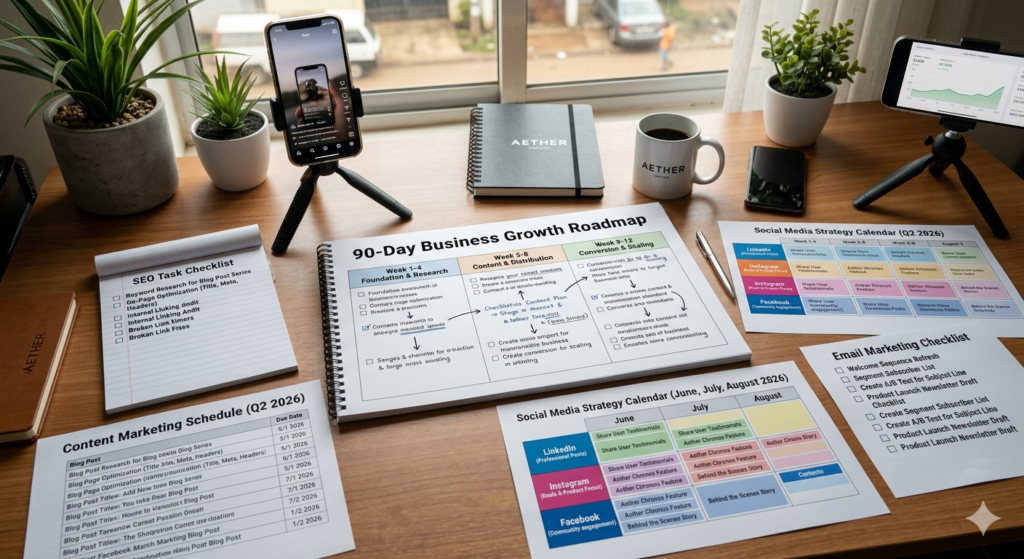
When learning how to start a business with no money, ideas alone are not enough.
Execution is what turns a concept into income.
This is why having a structured 90-day plan is critical when you want to start a business from scratch without capital.
Instead of trying everything at once, you focus on one stage at a time: foundation, customers, and growth.
Days 1–30: Foundation Phase
The first 30 days are about clarity and setup.
At this stage, your goal is not profit yet, but direction.
Focus on:
- Choosing a simple business model
- Defining your target audience
- Validating your idea
- Setting up free tools and platforms
- Creating your basic online presence
You should also begin learning what your audience truly needs.
If you are unsure what direction to choose, reviewing 12 Low-Capital Businesses You Can Start With $100 in 2026 can help you identify realistic opportunities that require minimal investment.
By the end of this phase, you should have a clear offer and a basic system ready for customers.
Days 31–60: Customer Acquisition Phase
Now you shift from setup to visibility.
This is where you actively begin attracting people.
Focus on:
- Publishing consistent content
- Engaging on social media
- Reaching out to potential customers
- Joining relevant communities
- Building early authority
You are not trying to be perfect.
You are trying to be visible.
At this stage, applying insights from First 10 Customers in 30 Days: A Practical Guide for New Small Businesses can significantly speed up your ability to generate early traction.
Days 61–90: Revenue Growth Phase
Now your focus shifts to converting interest into income.
At this stage, you should:
- Improve your offer based on feedback
- Refine your messaging
- Collect testimonials
- Strengthen your marketing channels
- Start reinvesting early profits
This is also where consistency becomes very important.
Businesses that apply structured growth thinking, similar to 9 Small Business Growth Strategies for Beginners, tend to scale more smoothly after their initial launch phase.
The Purpose of the 90-Day Plan
The goal of this plan is not overnight success.
The goal is momentum.
By the end of 90 days, you should have:
- A validated business idea
- Your first customers
- Early revenue
- A clearer understanding of your market
This is the stage where your business stops being an idea and starts becoming a real operating system.
And once that happens, you are no longer guessing.
You are building based on real data.
Next, we will answer the most common questions people ask when trying to start a business with no money, so you can remove any remaining confusion.
Frequently Asked Questions
Can I really start a business with no money?
Yes, you can.
When people search for how to start a business with no money, they often assume it means absolutely zero resources. In reality, it means starting without upfront capital while using skills, time, and free tools to generate income.
Many modern businesses have started using:
- free platforms
- social media
- personal skills
- service-based offers
- digital products
The key is not money, but execution.
What is the easiest business to start with zero capital?
The easiest businesses are usually service-based.
Examples include:
- freelancing
- consulting
- social media management
- graphic design
- writing services
- virtual assistance
These require skills more than money and allow you to start earning quickly.
If you want more ideas, the guide on 12 Low-Capital Businesses You Can Start With $100 in 2026 gives practical options that require minimal investment.
How long does it take to make money from a new business?
It depends on your strategy and consistency.
Some people make their first income within weeks by offering services or pre-selling products.
Others may take months if they focus on SEO or content-based strategies.
The faster path usually involves:
- service-based offers
- direct outreach
- solving urgent problems
What are the biggest challenges of bootstrapping?
The main challenges include:
- limited resources
- slower growth at the beginning
- lack of guidance
- Inconsistent income early on
However, bootstrapping also builds discipline and forces you to focus on profitability early.
This approach is central to understanding how to start a business from scratch without external funding.
Should I get funding before starting a business?
In most cases, no.
Funding should come after validation, not before.
If you raise money too early, you risk building something nobody wants.
A better approach is:
- Validate the idea
- Get customers
- Prove demand
- Then scale (if needed)
Many successful founders first build traction before seeking investment.
Final Thought
Learning how to start a business with no money is not about avoiding resources.
It is about using the resources you already have in a smarter way.
The businesses that succeed are not always the ones with the most funding.
They are the ones that start, adapt, and keep improving based on real customers.
Conclusion
Starting a business does not require a large amount of money.
What it truly requires is clarity, execution, and consistency.
If there is one thing to take away from this guide on how to start a business with no money, it is this:
You do not need funding to start; you need focus to begin.
Most successful businesses do not start with investors or big budgets. They start with simple ideas, are tested quickly, refined through feedback, and improved through real customer demand.
Throughout this blueprint, we explored how to:
- Choose the right low-cost business model
- Validate your idea before investing
- Use free tools and resources
- attract your first customers without ads
- reach your first $1,000 in revenue
- avoid common bootstrapping mistakes
- build a structured 90-day launch plan
Each step is designed to help you start a business from scratch using what you already have instead of waiting for what you do not.
The truth is, money often becomes available after momentum is created, not before.
Once you begin generating results, you can reinvest, scale, and improve your systems over time.
But the starting point is always the same:
Take action with what you already have.
If you are still unsure where to begin, revisit earlier strategies in 9 Small Business Growth Strategies for Beginners or explore foundational planning insights in How to Create a Winning Business Plan for Startups Step-by-Step to strengthen your direction.
The opportunity is not missing.
It is already available.
The only question is whether you will start now or continue waiting.
And in business, those who start always learn faster than those who wait.
THANKS FOR READING
BY WISDOM SAMUAEL