

INTRODUCTION: WHY STARTING A BUSINESS LEGALLY MATTERS MORE THAN MOST PEOPLE THINK

If you’re wondering how to start a business legally, you’re already asking one of the smartest questions a new entrepreneur can ask. Many people focus on finding customers, making sales, and growing revenue, but overlook the legal foundation that protects everything they’re trying to build.
I’ve seen aspiring business owners spend months developing products, creating websites, and promoting their services, only to run into avoidable problems because they ignored legal requirements. In some cases, it leads to fines. In others, it creates tax issues, licensing problems, or disputes that could have been prevented from the beginning.
The reality is that starting a business legally is about more than paperwork. It is about protecting yourself, your finances, your reputation, and your future growth. A properly structured business often has an easier time opening bank accounts, working with larger clients, securing partnerships, and building trust with customers.
Unfortunately, many entrepreneurs assume they can “fix the legal side later.” While some small informal businesses may operate this way for a while, delaying compliance can become expensive as the business grows. What starts as a simple oversight can turn into penalties, missed tax obligations, or challenges when trying to scale.
Before investing significant time or money in any venture, I always recommend ensuring the business idea itself is worth pursuing. That’s why it’s important first to validate demand using a process like the one explained in How to Validate a Business Idea Before Investing: Stop Wasting Cash on Wrong Products, before moving into registration and compliance.
In this guide, I’ll walk you through the legal steps to start a business, from validating your idea and choosing a legal structure to registration, licenses, taxes, and business protection. By the end, you’ll have a practical roadmap for building a business that is not only profitable but also legally secure.
WHAT DOES IT MEAN TO START A BUSINESS LEGALLY?
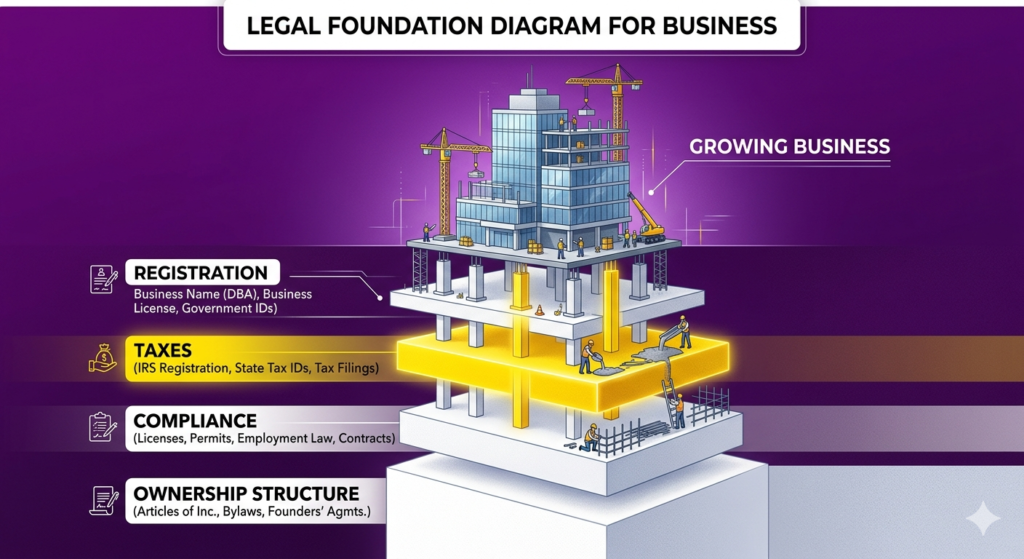
Many new entrepreneurs hear the phrase “start a business legally” but are not entirely sure what it actually means. Some assume it only involves registering a business name. Others believe it is something they can worry about after they begin making money. In reality, operating legally involves several responsibilities that work together to protect both the business owner and the business itself.
At its core, starting a business legally means establishing your business in accordance with the laws and regulations that apply to your location and industry. This typically includes registering your business, complying with tax requirements, obtaining necessary licenses or permits, and following any industry-specific regulations.
Legal ownership is one of the first pieces of the puzzle. When you officially register a business, you create a recognized entity that can operate under a business name, enter into contracts, and, depending on the structure you choose, provide certain legal protections.
Another important component is taxation. Most governments require businesses to report income, maintain records, and pay applicable taxes. Ignoring these responsibilities can lead to penalties that become increasingly difficult to resolve as the business grows. For beginner-friendly tax guidance, resources such as the Internal Revenue Service (IRS) Small Business Center provide helpful explanations of common business tax obligations.
Compliance is also part of operating legally. This can include maintaining licenses, renewing permits, meeting industry standards, and following consumer protection or privacy requirements where applicable.
The biggest difference between operating legally and operating informally is sustainability. An informal business may generate income in the short term, but a legally established business is positioned for long-term growth, credibility, partnerships, and financial opportunities.
Think of legal compliance as the foundation of a building. Customers may never see it, but without it, everything built on top becomes vulnerable. The stronger your foundation, the easier it becomes to grow with confidence.
STEP 1: VALIDATE YOUR BUSINESS IDEA BEFORE REGISTERING ANYTHING
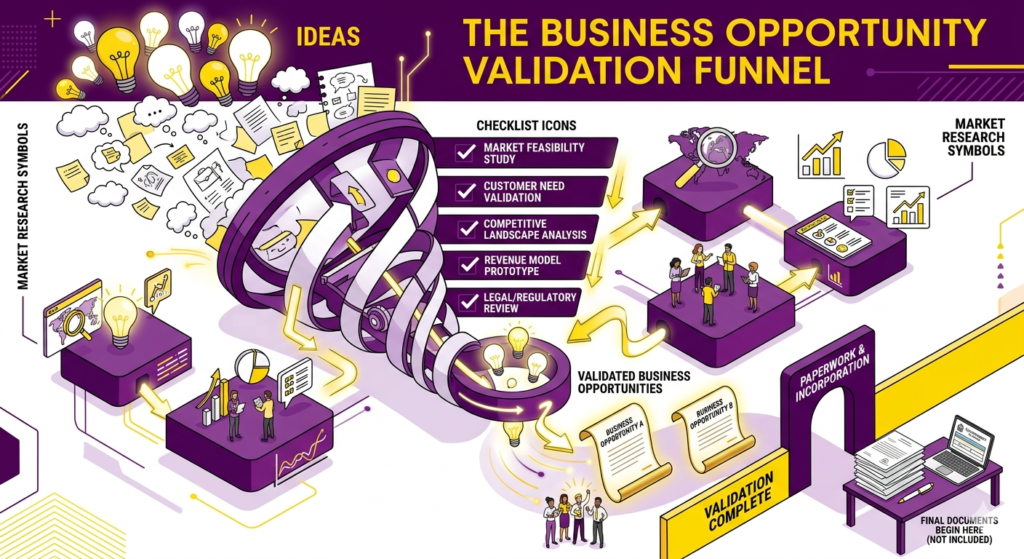
One of the biggest mistakes I see new entrepreneurs make is rushing into registration before confirming whether their business idea actually has demand. They pay registration fees, buy domains, print business cards, and sometimes even rent office space before they know if customers want what they are selling.
The truth is simple: validation should come before paperwork.
Just because you are excited about an idea does not mean the market will buy it. Many businesses fail not because the owners lacked motivation, but because they built something nobody wanted to buy.
Before registering anything, take time to answer a few important questions:
- Does this idea solve a real problem?
- Are people actively looking for a solution?
- Is there an existing market?
- Will customers be willing to pay for it?
- Can I test demand with minimal investment?
The goal is to gather evidence, not assumptions.
A practical way to do this is by talking to potential customers, studying competitors, running surveys, creating a simple landing page, or offering a basic version of your product or service before making larger commitments. These methods help you understand whether demand exists before you invest significant time or money.
This approach is especially important for beginners because registration costs, licensing fees, and setup expenses can add up quickly. Validating first reduces the risk of spending money on an idea that never gains traction.
If you want a complete framework for testing demand, researching the market, and avoiding costly mistakes, I strongly recommend reading How to Validate a Business Idea Before Investing: Stop Wasting Cash on Wrong Products. It walks you through the entire business idea validation process step by step.
Another benefit of validation is confidence. When you move into business registration after seeing real interest from potential customers, you are no longer operating on hope alone. You are making decisions based on evidence.
Think of validation as the first legal protection for your business. While it may not involve lawyers or paperwork, it protects you from one of the most expensive mistakes entrepreneurs make: building a business around an idea that has no market demand.
Once you have validated your concept, you can move forward with registration knowing that you are building on a stronger foundation.
STEP 2: CHOOSE THE RIGHT LEGAL BUSINESS STRUCTURE
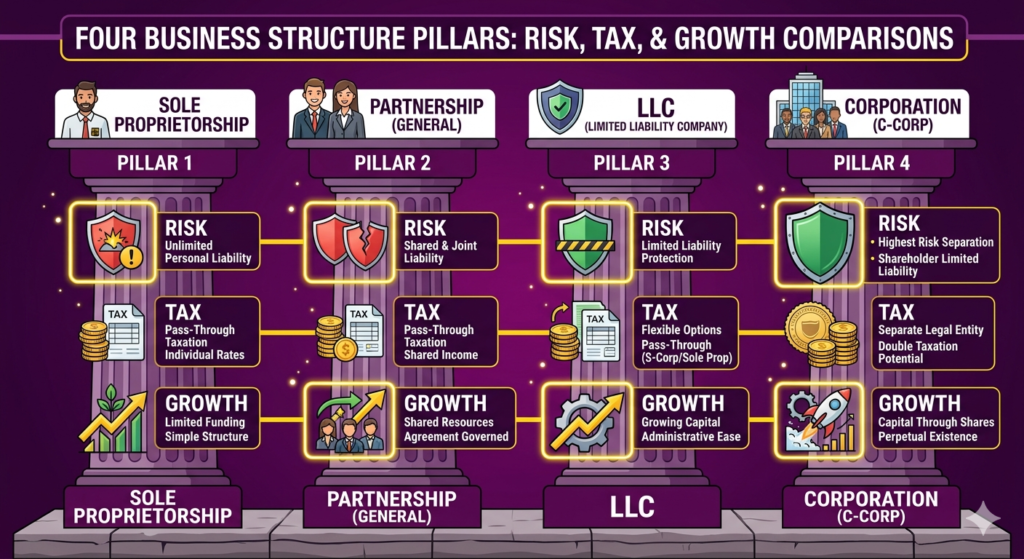
One of the most important decisions you’ll make when learning how to start a business legally is choosing the right legal structure. This decision affects your taxes, personal liability, paperwork requirements, and even your ability to raise capital in the future.
Many beginners rush through this step because they are eager to launch. However, selecting the wrong structure can create unnecessary complications later.
Let’s look at the most common options.
Sole Proprietorship
A sole proprietorship is the simplest business structure and is often the default option for individuals starting a business alone.
Advantages:
- Easy to set up
- Low cost
- Minimal paperwork
- Full control over business decisions
Disadvantages:
- No separation between personal and business assets
- You are personally responsible for debts and legal claims
This structure is often suitable for freelancers, consultants, and small side businesses that are just getting started.
Partnership
A partnership is formed when two or more people own a business together.
Advantages:
- Shared responsibilities
- Combined skills and resources
- Easier startup process than corporations
Disadvantages:
- Shared liability in many cases
- Potential conflicts between partners
- Profit-sharing obligations
Before entering a partnership, I strongly recommend having a written partnership agreement in place.
Limited Liability Company (LLC)
An LLC is one of the most popular business structures because it provides liability protection while remaining relatively simple to manage.
Advantages:
- Separates personal and business assets
- Flexible tax treatment
- Greater credibility with customers and partners
Disadvantages:
- Higher registration costs in some jurisdictions
- Additional compliance requirements
For many small business owners, an LLC provides a balance between protection and simplicity.
If you’d like a deeper explanation of LLCs and other structures, the U.S. Small Business Administration’s Business Structure Guide offers an excellent overview.
Corporation
A corporation is a separate legal entity from its owners and is often used by businesses planning significant growth, outside investment, or public offerings.
Advantages:
- Strong liability protection
- Easier access to investment capital
- Long-term growth potential
Disadvantages:
- More paperwork
- Higher compliance obligations
- More complex tax and reporting requirements
HOW TO CHOOSE THE RIGHT STRUCTURE
When deciding, consider:
- Your level of risk
- Expected revenue
- Number of owners
- Future growth plans
- Tax implications
A freelance designer may be comfortable starting as a sole proprietor, while a company planning to hire employees and seek investors may benefit from an LLC or corporation.
There is no universal “best” structure. The right choice depends on your goals, industry, and circumstances.
As your business grows, your structure may evolve. The key is choosing the option that provides the right balance of protection, flexibility, and simplicity for where your business is today.
STEP 3: REGISTER YOUR BUSINESS NAME AND ENTITY

Once you have validated your idea and selected a legal business structure, the next step is making your business official through registration. This is where your business begins to exist as a recognized entity rather than just an idea.
Many entrepreneurs treat this as a simple paperwork exercise, but there is more to it than filling out forms. The decisions you make here can affect your branding, credibility, and future growth.
START WITH A BUSINESS NAME SEARCH
Before you become attached to a business name, check whether it is available.
One of the most frustrating mistakes beginners make is building a brand around a name only to discover that another business already owns it or is using something very similar.
When evaluating a business name, ask:
- Is it easy to remember?
- Is it easy to spell?
- Does it reflect what the business does?
- Can it grow with the business in the future?
Many government registration agencies provide online databases where you can search for existing business names before applying.
CHECK DOMAIN NAME AVAILABILITY
Even if you are not planning to launch a website immediately, checking domain availability is important.
A website often becomes your digital headquarters. If the matching domain is unavailable, you may need to adjust your business name before registration.
You can search domain availability using tools such as ICANN Lookup or domain registrars like Namecheap.
CONSIDER TRADEMARK PROTECTION
Business registration and trademarks are not the same thing.
Registering a business usually permits you to operate under a specific name in your jurisdiction. A trademark provides additional protection for your brand identity.
If you are building a long-term brand, it is worth understanding trademark basics early. The World Intellectual Property Organization (WIPO) offers excellent educational resources on trademarks and intellectual property protection.
COMPLETE THE REGISTRATION PROCESS
The exact registration process varies by country and region, but generally involves:
- Choosing a legal structure
- Submitting registration documents
- Paying registration fees
- Receiving official registration confirmation
- Obtaining any required tax identification numbers
Always verify the requirements with your local government or business registration authority.
COMMON MISTAKES BEGINNERS MAKE
Over the years, I have seen entrepreneurs make several avoidable mistakes during registration:
- Registering before validating demand
- Choosing names that are difficult to spell or remember
- Ignoring domain availability
- Failing to research trademarks
- Selecting a legal structure without understanding the consequences
One reason I encourage entrepreneurs to plan carefully before registration is that changing names, structures, or branding later can become expensive and time-consuming.
This is also where having a clear business plan becomes valuable. If you have not created one yet, I recommend reading How to Create a Winning Business Plan for Startups: Step-by-Step 2026 Guide. A strong business plan can help you make smarter decisions before committing to registration.
Registering your business may feel like a small step, but it is one of the first major milestones in transforming an idea into a legitimate business.
STEP 4: OBTAIN THE NECESSARY LICENSES AND PERMITS
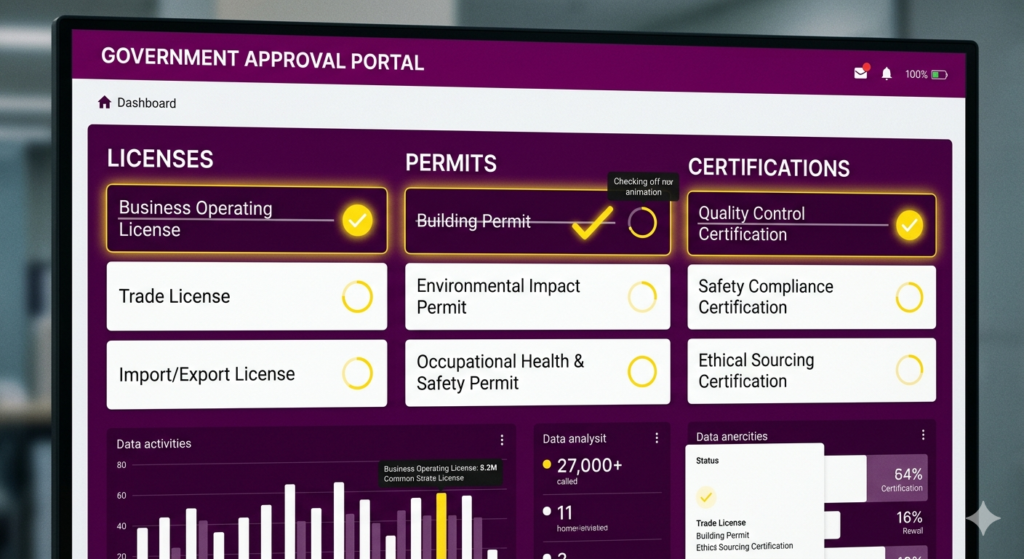
Many new entrepreneurs assume that once their business is registered, they are ready to start operating. Unfortunately, that is not always the case. Depending on your industry, location, and business activities, you may need additional licenses, permits, or certifications before you can legally serve customers.
This is one of the most overlooked small business legal requirements, and it can become expensive if ignored.
The exact licenses you need will vary based on where you operate and what you sell. That is why it is important to check requirements with your local government, municipal authority, or industry regulator before launching.
INDUSTRY-SPECIFIC LICENSES
Some industries have stricter regulations than others because they directly affect public health, safety, or finances.
Examples include:
- Restaurants and food businesses
- Healthcare services
- Financial consulting
- Childcare services
- Transportation businesses
- Construction companies
For example, opening a restaurant may require food handling certifications, health inspections, and operating permits before serving customers.
HOME-BASED BUSINESS PERMITS
Many entrepreneurs start businesses from home, especially in the early stages.
However, operating from home does not automatically exempt you from regulations.
Depending on your location, you may need:
- Home occupation permits
- Zoning approvals
- Signage permits
- Local business licenses
This is particularly important if customers visit your property or if your business activity affects your neighborhood.
PROFESSIONAL LICENSES AND CERTIFICATIONS
Certain professions require formal licensing before offering services.
Examples include:
- Lawyers
- Accountants
- Architects
- Medical professionals
- Real estate agents
In these industries, operating without the required credentials can lead to penalties, legal action, or the inability to practice legally.
HOW TO FIND THE REQUIREMENTS FOR YOUR BUSINESS
One mistake I often see is entrepreneurs relying on assumptions or advice from social media instead of checking official sources.
A much better approach is to consult government business resources. The U.S. Small Business Administration Business Licenses and Permits Guide provides a useful example of how licensing requirements are organized. Even if you operate outside the United States, it gives you a good understanding of the types of permits businesses commonly need.
You should also check:
- National government websites
- Local council or municipal offices
- Industry regulators
- Professional associations
WHY THIS STEP MATTERS
Licenses and permits are not just bureaucratic paperwork. They help ensure businesses operate safely, ethically, and within the law.
Operating without required permits can lead to:
- Fines and penalties
- Forced business closures
- Loss of credibility
- Legal disputes
I’ve seen entrepreneurs spend months building momentum only to discover they lacked a required permit. Fixing the issue later often costs far more than handling it correctly from the start.
As your business grows, compliance becomes even more important. Understanding these requirements early helps you avoid setbacks and build a stronger foundation for long-term success.
Once your licenses and permits are in place, the next step is organizing your finances properly, something many entrepreneurs underestimate until it becomes a problem.
STEP 5: SEPARATE YOUR BUSINESS AND PERSONAL FINANCES
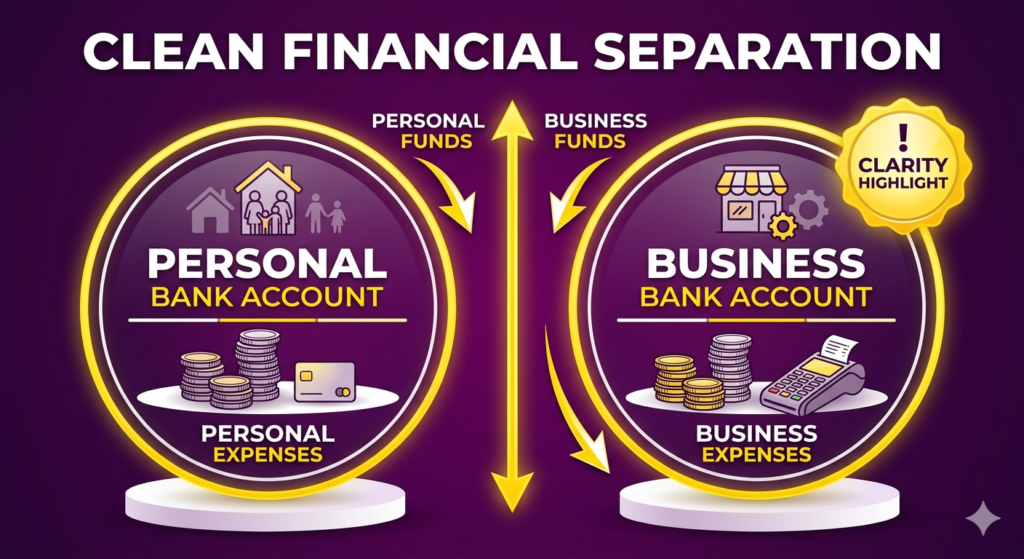
One of the fastest ways to create financial and legal problems in a business is to mix personal and business money. It may seem harmless in the beginning, especially if you’re a solo entrepreneur, but this habit can quickly become a nightmare when tax season arrives or when you need to understand how your business is actually performing.
I’ve seen many small business owners struggle because they used one bank account for everything. Personal shopping, business expenses, client payments, and household bills were all mixed. When it came time to calculate profits or prepare tax records, they had no clear picture of where their money was going.
OPEN A BUSINESS BANK ACCOUNT
As soon as your business is legally established, consider opening a dedicated business bank account.
This helps you:
- Track business income accurately
- Separate personal and business expenses
- Build professional credibility
- Simplify accounting and tax reporting
- Maintain cleaner financial records
Many banks now offer business accounts specifically designed for startups and small businesses.
CREATE A SIMPLE ACCOUNTING SYSTEM
You do not need a complicated financial setup on day one. What you do need is a system that allows you to track every transaction.
Record:
- Sales and revenue
- Business expenses
- Supplier payments
- Marketing costs
- Equipment purchases
- Taxes paid
The earlier you develop this habit, the easier it becomes to manage growth later.
TRACK EVERY EXPENSE
Small expenses often seem insignificant until they add up.
A monthly software subscription, internet costs, transportation, advertising, and business supplies can collectively represent a substantial portion of your operating costs.
Keeping accurate records helps you understand profitability and identify areas where money is being wasted.
USE THE RIGHT TOOLS
Technology can make financial management much easier. Accounting software, invoicing tools, and expense trackers help automate many of the tasks that business owners often neglect.
If you’re looking for practical tools that support organization, productivity, and growth, I recommend reading 11 Essential Tools That Support Small Business Growth in 2026. Many of these tools can save hours of administrative work every month.
For a deeper understanding of small business bookkeeping basics, the SCORE Small Business Accounting Guide provides useful beginner-friendly insights.
THINK LONG TERM
Separating finances is not just about convenience. It strengthens your legal protection, improves financial visibility, and makes it easier to secure loans, attract investors, or work with professional accountants in the future.
A business that treats its finances seriously from day one is usually better prepared for growth than one that tries to organize everything after problems appear.
STEP 6: UNDERSTANDING TAX OBLIGATIONS BEFORE YOU START SELLING

Taxes are one of the least exciting parts of running a business, but they are also one of the most important. Many entrepreneurs focus on making sales and attracting customers while completely overlooking their tax responsibilities. Unfortunately, ignoring taxes does not make them disappear. In fact, tax problems often become more expensive the longer they are ignored.
One of the smartest things you can do when learning how to start a business legally is to understand your tax obligations before you begin selling products or services.
UNDERSTANDING THE TYPES OF BUSINESS TAXES
The exact taxes you pay will depend on your country, business structure, and industry. However, most businesses encounter some combination of:
- Income tax
- Sales or value-added tax (VAT)
- Payroll taxes (if you hire employees)
- Local business taxes or fees
For many beginners, income tax is the easiest to understand. If your business earns a profit, a portion of that profit may be taxable according to local laws.
Sales taxes or VAT can be more complex because businesses often collect these taxes from customers and then remit them to the appropriate government authority.
KEEP ACCURATE RECORDS FROM DAY ONE
Poor record-keeping is one of the biggest reasons small businesses encounter tax problems.
Make it a habit to keep records of:
- Revenue and sales
- Business expenses
- Invoices
- Receipts
- Bank statements
- Tax payments
Good records make filing taxes easier and provide evidence if questions ever arise.
DON’T WAIT UNTIL TAX SEASON
A common mistake is treating taxes as a once-a-year activity.
Successful business owners prepare throughout the year. Setting aside money for taxes as revenue comes in can prevent unpleasant surprises later.
Many entrepreneurs find it helpful to automatically reserve a percentage of each payment received so tax obligations do not consume cash needed for operations.
KNOW WHEN TO SEEK PROFESSIONAL HELP
While it is useful to understand the basics, there comes a point where professional advice can save significant time and money.
An accountant or qualified tax professional can help you:
- Understand local tax requirements
- Identify legitimate deductions
- Maintain compliance
- Avoid costly mistakes
This is particularly valuable as your business grows or if your tax situation becomes more complex.
USE TRUSTED RESOURCES
For a deeper understanding of small business tax responsibilities, the IRS Small Business and Self-Employed Tax Center offers extensive educational resources. Even if you operate outside the United States, many of the principles regarding record-keeping and tax planning remain useful.
The key lesson is simple: taxes should never be an afterthought. When you understand your obligations early and build good financial habits, compliance becomes much easier and far less stressful.
A legally compliant business is not just one that is registered. It is one that consistently meets its financial and tax responsibilities as it grows.
STEP 7: CREATE BASIC LEGAL PROTECTION FOR YOUR BUSINESS

Once your business is registered, structured, and running legally, the final step is protecting it. Many entrepreneurs assume legal protection is only for large companies, but in reality, even small businesses need basic safeguards from the beginning.
If you are learning how to start a business legally, this step ensures that your effort, brand, and income are protected from avoidable disputes and risks.
USE SIMPLE CONTRACTS FOR EVERY AGREEMENT
One of the most common legal mistakes small business owners make is relying on verbal agreements.
While trust is important, misunderstandings happen easily when expectations are not written down.
A simple contract should clearly define:
- What service or product is being provided
- Payment terms and deadlines
- Responsibilities of both parties
- Delivery timelines
- What happens if either party fails to deliver
Even a basic written agreement can prevent serious disputes later.
CREATE TERMS AND CONDITIONS
If you sell products or services online, terms and conditions help set clear rules for how customers interact with your business.
They typically cover:
- Payment policies
- Refund and return rules
- Delivery terms
- Limitations of liability
- User responsibilities
This is especially important for e-commerce and digital businesses.
ADD A PRIVACY POLICY IF YOU COLLECT DATA
If your business collects customer information such as emails, phone numbers, or payment details, a privacy policy is essential.
It explains how customer data is collected, used, and protected.
For deeper guidance on data protection principles, resources like the World Intellectual Property Organization (WIPO) and local data protection authorities can provide region-specific rules and best practices.
CONSIDER BASIC BUSINESS INSURANCE
Insurance is often overlooked by beginners, but it provides an extra layer of protection.
Depending on your business type, you may need:
- General liability insurance
- Professional liability insurance
- Property insurance
- Product liability coverage
Insurance helps protect your business from unexpected losses, accidents, or claims.
UNDERSTANDING INTELLECTUAL PROPERTY BASICS
Your brand, logo, content, and unique ideas are part of your intellectual property.
While full trademark registration may not be necessary immediately, it is important to understand how to protect your work from being copied or misused.
If you want to explore this further, the World Intellectual Property Organization (WIPO) Intellectual Property Guide is a helpful starting point.
WHY THIS STEP MATTERS
Without legal protection, even a growing business can face challenges such as disputes, copycats, or unclear agreements with clients.
Think of legal protection as a safety shield. It does not stop you from doing business, but it protects everything you are building.
A business that is legally protected is more stable, more professional, and more attractive to serious clients and partners.
At this stage, your business is no longer just an idea. It is a structured, compliant, and protected entity ready for growth.
THE LEGAL MISTAKES THAT GET SMALL BUSINESSES INTO TROUBLE
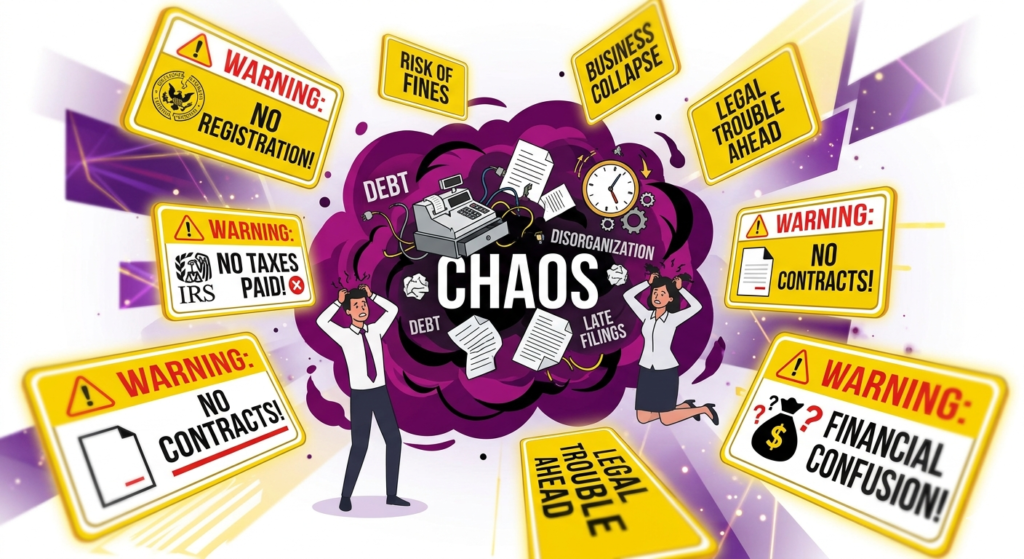
Even when entrepreneurs understand how to start a business legally, many still make avoidable mistakes that put their business at risk later. These mistakes are often not intentional, but they usually come from rushing the process or ignoring small details that seem unimportant at the beginning.
One of the most common mistakes is operating without proper registration. Some business owners delay registration because they want to “test first,” but continue running the business for too long without formalizing it. This can create legal and tax complications once the business starts generating consistent income.
Another major issue is mixing personal and business finances. When money flows through the same account, it becomes difficult to track profits, calculate taxes, or prove business income. This also weakens your financial credibility if you ever need funding or partnerships.
Ignoring tax obligations is another serious mistake. Many beginners assume taxes only matter when the business becomes large, but tax responsibilities often begin as soon as income is generated. Failing to prepare early can lead to penalties or unexpected financial pressure.
Relying only on verbal agreements is also risky. Without written contracts, misunderstandings with clients, suppliers, or partners can quickly turn into disputes that are hard to resolve.
Finally, skipping insurance leaves businesses exposed to risks they may not be financially prepared for. Even a small accident, legal claim, or product issue can create unexpected costs that affect business stability.
The key lesson here is simple: most legal problems do not happen because entrepreneurs are careless, but because they underestimate the importance of structure and documentation in the early stages.
A legally sound business does not avoid all risks, but one that is prepared for them.
Avoiding these mistakes early helps you build a business that is stable, credible, and easier to scale in the long run.
A SIMPLE BUSINESS LEGAL CHECKLIST FOR BEGINNERS
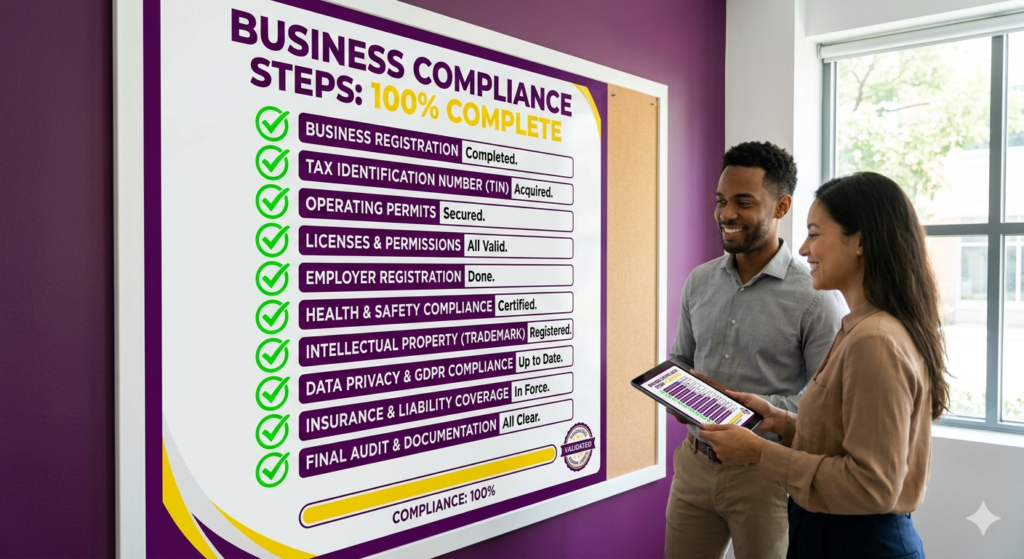
If you are serious about building a business the right way, you need a clear legal checklist that keeps you on track. Many entrepreneurs get overwhelmed because they try to handle everything at once. This checklist breaks the process into simple, actionable steps so you can move forward with confidence.
Think of it as your “before you scale” foundation.
STEP 1: VALIDATE YOUR IDEA
Before spending money on registration or setup, confirm that your business idea has real demand. Make sure people actually need the solution and are willing to pay for it.
STEP 2: CHOOSE YOUR BUSINESS STRUCTURE
Decide whether you are operating as a sole proprietorship, partnership, LLC, or corporation, depending on your goals, risk level, and future plans.
STEP 3: REGISTER YOUR BUSINESS
Secure your business name and register your entity with the appropriate government authority. Ensure your chosen name is available and not already in use.
STEP 4: OBTAIN LICENSES AND PERMITS
Check if your industry requires special permits, certifications, or local licenses before you begin operations.
STEP 5: OPEN A BUSINESS BANK ACCOUNT
Separate your personal and business finances immediately to maintain clarity and avoid accounting issues later.
STEP 6: SET UP TAX OBLIGATIONS
Understand how your business will be taxed, keep proper records, and prepare to file taxes based on your local requirements.
STEP 7: CREATE BASIC LEGAL DOCUMENTS
Prepare contracts, terms and conditions, and privacy policies if you collect customer data or provide services.
FINAL REMINDER
Completing this checklist does not just make your business legal. It makes your business structured, credible, and easier to grow.
Many entrepreneurs skip these steps and later struggle with confusion, penalties, or financial mismanagement. Taking time to set things up properly gives you a stronger foundation than most beginners ever build.
If you are still unsure about whether your idea is worth investing in before completing this checklist, it is worth revisiting How to Validate a Business Idea Before Investing: Stop Wasting Cash on Wrong Products.
Strong businesses are not built by chance. They are built by following the right steps in the right order.
FREQUENTLY ASKED QUESTIONS ABOUT STARTING A BUSINESS LEGALLY
Can I start a business without registering it?
Yes, in some cases, you can start very small without formal registration, especially for testing an idea. However, once your business begins generating consistent income or operating publicly, registration becomes important for legal protection, taxes, and credibility.
What licenses do I need to start a business?
It depends on your industry and location. Some businesses need basic local business licenses, while others require industry-specific permits such as food handling, health certifications, or professional licenses. Always check with your local government or regulatory authority before launching.
Do I need a business bank account?
While not always legally required for very small businesses, a business bank account is highly recommended. It helps you separate personal and business finances, track income properly, and maintain clean financial records for taxes and reporting.
How much does business registration cost?
The cost varies widely depending on your country, business structure, and registration type. Some registrations are low-cost, while others (especially formal entities like corporations) can be more expensive due to filing fees and legal requirements.
When should I hire a lawyer?
You do not need a lawyer for every step, but it is wise to consult one when:
- Drafting complex contracts
- Forming partnerships
- Protecting intellectual property
- Scaling into larger operations
- Dealing with disputes or legal uncertainty
KEY INSIGHT
Starting a business legally is not about complexity. It is about following the right steps early, so you avoid problems later.
If you want to connect legal setup with business planning and growth strategy, you can also explore How to Create a Winning Business Plan for Startups: Step-by-Step 2026 Guide. It helps you structure your business before and after registration.
A well-prepared entrepreneur reduces risk, builds trust faster, and scales with fewer obstacles.
FINAL THOUGHTS: BUILD YOUR BUSINESS ON A LEGAL FOUNDATION
Starting a business legally is not just about avoiding trouble; it is about building something that can last. Many entrepreneurs focus heavily on getting sales and growing fast, but overlook the foundation that keeps the business stable when challenges come.
If there is one idea to take from this guide, it is this: legal setup is not a delay to success; it is part of success.
When your business is properly structured, registered, and compliant, you gain more than just legal protection. You gain credibility with customers, trust from partners, and confidence in your own operations. It becomes easier to open accounts, work with institutions, and scale without unnecessary setbacks.
I have seen businesses struggle not because they lacked customers, but because they ignored the basics early on. Simple things like unclear ownership, missing permits, or poor financial separation can create problems that slow down growth later.
On the other hand, businesses that take time to set things up correctly tend to grow with fewer interruptions. They are more organized, more professional, and more prepared for long-term expansion.
If you are just starting out, do not rush past this stage. Take the time to validate your idea, choose the right structure, register properly, and set up your legal and financial systems. These steps may feel small now, but they will protect everything you build in the future.
And if you are still shaping your idea, it is worth revisiting How to Validate a Business Idea Before Investing: Stop Wasting Cash on Wrong Products before committing fully.
A strong business is not built on speed alone. It is built on structure, patience, and doing things the right way from the beginning.